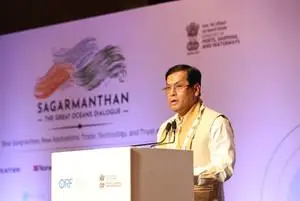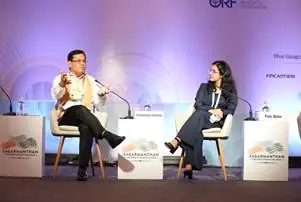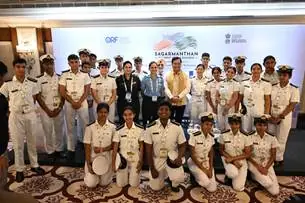
Union Minister Sarbananda Sonowal has framed India's maritime future around a three-part agenda: deeper global partnerships, stronger participation by young people, and expanded opportunities for women in the sector. The emphasis reflects a broader policy shift in New Delhi, where maritime development is increasingly being treated not merely as an infrastructure story, but as a strategic economic and human-capital project.
Sonowal's message comes at a time when India is seeking to strengthen its position across shipping, ports, logistics, coastal industry and blue economy-linked services. The government has been pushing to modernize maritime assets, improve connectivity and attract investment into port-led development. In that context, the minister's focus on partnerships suggests an effort to align domestic capacity with international expertise, capital and technology.
Global Maritime Push
The minister's emphasis on global partnerships indicates that India is looking beyond its own coastline to shape a more integrated maritime ecosystem. For a country with a long shoreline and expanding trade ambitions, the maritime sector is increasingly tied to supply-chain resilience, export competitiveness and strategic autonomy. Cooperation with foreign stakeholders can accelerate technology transfer, improve operational standards and open new commercial channels for Indian firms.
This approach also reflects the reality that maritime growth today is highly networked. Ports, shipping lines, logistics operators, shipbuilders and training institutions all depend on cross-border coordination. By placing partnerships at the center of the conversation, Sonowal is signaling that India's maritime rise will likely be built through collaboration rather than isolation.
The policy framing is also consistent with India's larger economic diplomacy. As the country seeks to expand trade routes and strengthen its role in the Indo-Pacific, maritime infrastructure becomes a key instrument of statecraft. Ports are no longer just cargo-handling points; they are strategic nodes in a wider architecture of commerce, security and connectivity.
Youth As Growth Engine
Sonowal's focus on youth underscores a recognition that the maritime sector will need a new generation of skilled workers, managers, engineers and digital specialists. The industry is changing rapidly, with automation, data-driven logistics and greener shipping practices reshaping job profiles. That makes talent development as important as physical infrastructure.
For India, where a large working-age population is often described as a demographic dividend, the challenge is to convert that advantage into employable skills. Maritime careers can offer that bridge if training systems, apprenticeships and industry linkages are expanded. The minister's remarks suggest that the government wants young Indians to see the sector not as a niche domain, but as a major avenue for long-term employment and entrepreneurship.
This is especially relevant as India tries to deepen domestic manufacturing and logistics capabilities. A more skilled maritime workforce can support port efficiency, vessel operations, coastal shipping and allied services. In practical terms, youth inclusion is not only a social objective; it is a competitiveness strategy.
Women In Maritime
The inclusion of women in Sonowal's vision is equally significant. Maritime industries across the world have historically been male-dominated, particularly in operational and technical roles. By explicitly naming women as central to the sector's future, the minister is reinforcing a broader policy message about inclusion, diversity and access to opportunity.
This matters because the maritime economy spans far more than seafaring. It includes administration, engineering, logistics, legal services, environmental management, digital systems and port governance, all of which can benefit from a wider talent pool. Greater participation by women can improve institutional performance, broaden leadership pipelines and make the sector more representative of the society it serves.
The challenge will be translating rhetoric into measurable outcomes. That requires safe workplaces, training access, mentorship, recruitment pathways and institutional support. If those elements are built into maritime policy, women's participation could become a durable feature of the sector rather than a symbolic aspiration.
Taken together, Sonowal's message points to a maritime agenda that is as much about people as it is about ports. India's ambitions in shipping and coastal development will depend not only on capital expenditure and regulatory reform, but also on whether the country can mobilize global cooperation while building a more inclusive domestic workforce. In that sense, the minister's framing places human capital at the heart of maritime strategy, where it may prove to be one of the most decisive factors in India's next phase of growth.