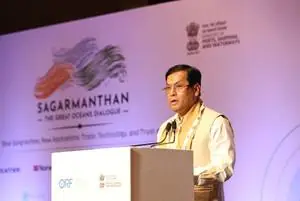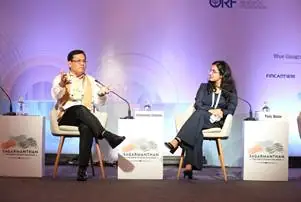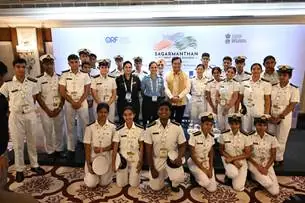
Union Minister Sarbananda Sonowal has positioned India's maritime future as a strategic national project that must be shaped not only by infrastructure and trade, but also by people, partnerships and inclusion. In remarks that underscore the government's broader blue economy push, Sonowal placed global cooperation, youth engagement and women's participation at the center of the sector's next phase of growth.
The minister's framing reflects a wider policy shift in New Delhi: maritime development is no longer being treated as a narrow logistics issue, but as a pillar of economic security, industrial competitiveness and international connectivity. India's coastline, ports, shipping lanes and inland water systems are increasingly being viewed as assets that can support manufacturing, exports, energy transport and regional influence. Against that backdrop, Sonowal's emphasis on human capital suggests the government wants the maritime sector to be both technologically modern and socially inclusive.
Global Maritime Linkages
Sonowal's focus on global partnerships comes at a time when India is seeking to deepen its role in international shipping networks and port-led trade corridors. For a country that depends heavily on sea routes for imports, exports and energy supplies, maritime cooperation has become central to economic resilience. Partnerships with foreign governments, port operators, shipbuilders, technology firms and maritime institutions can help India accelerate modernization, improve efficiency and strengthen supply-chain reliability.
The minister's message also aligns with India's broader diplomatic posture in the Indo-Pacific, where maritime connectivity is increasingly tied to strategic influence. As global trade patterns shift and supply chains are reconfigured, India is looking to present itself as a dependable node in regional commerce. That requires not only physical infrastructure, but also regulatory coordination, digital systems, skilled personnel and international standards.
Youth And Skills Push
A second theme in Sonowal's intervention was the role of young Indians in shaping the sector's future. That emphasis is significant because the maritime economy has traditionally been associated with legacy institutions and technical occupations that often remain outside the public imagination. By highlighting youth, the minister is signaling that the sector must become more visible, more aspirational and more accessible to the next generation of engineers, seafarers, logistics specialists, marine technologists and policy professionals.
This is also consistent with India's broader employment challenge. As the country seeks to create large-scale jobs for a growing workforce, sectors that combine technical training, industrial expansion and export potential are likely to receive greater policy attention. Maritime industries can offer such opportunities, but only if training pipelines, certification systems and career pathways are strengthened. Sonowal's remarks suggest the government sees talent development as essential to converting maritime ambition into durable capacity.
Women In Maritime Growth
Perhaps the most notable element of the minister's message was his explicit inclusion of women in the maritime vision. In a sector that has historically been male-dominated, this is more than a symbolic gesture. It points to a recognition that India's maritime expansion will be limited unless women are able to participate across operational, technical, administrative and leadership roles.
Greater inclusion of women can broaden the talent pool, improve institutional diversity and help modernize workplace culture across ports, shipping companies and maritime agencies. It also reflects a wider national conversation about gender participation in sectors that have long been closed off by convention rather than capability. If translated into policy, this could mean stronger recruitment, targeted training, safer workplace environments and clearer advancement routes for women entering the field.
The minister's remarks come at a moment when India is trying to project itself as a maritime power with both scale and credibility. That ambition will depend on hard infrastructure, but also on whether the sector can attract skilled young workers, integrate women more fully and build durable international partnerships. Sonowal's intervention suggests the government wants the maritime story to be about more than ships and ports. It wants it to be about national capability, global relevance and a broader social base for growth.