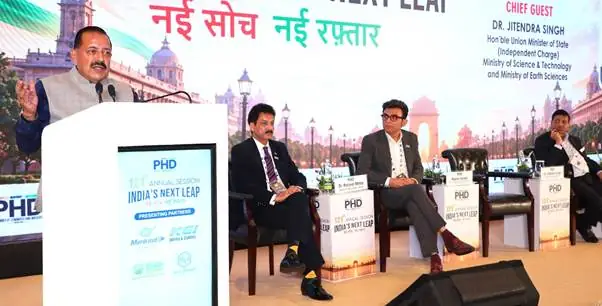
Union Minister of State for Science and Technology Jitendra Singh has urged the private sector to play a far more assertive role in turning Indian innovation into commercial products and strategic capabilities, arguing that the country's long-term sovereignty will depend not only on scientific discovery but on the speed with which those discoveries are converted into industrial strength.
Speaking in the context of India's broader development goals, Singh framed innovation as a national asset that must be scaled through industry participation, market discipline and stronger links between research institutions and enterprise. His message reflects a growing policy consensus in New Delhi: India can no longer treat research as an end in itself. The real test lies in whether laboratories, startups and public institutions can collectively build technologies that are economically viable, globally competitive and strategically relevant.
Innovation to Industry
Singh's call comes at a time when India is seeking to deepen domestic manufacturing, reduce dependence on critical imports and strengthen resilience across sectors ranging from advanced materials and electronics to space, biotech and clean energy. The minister's emphasis on commercialisation is significant because India has long been recognised for its scientific talent and entrepreneurial energy, yet has often struggled to convert research output into large-scale industrial adoption.
That gap has become more consequential as governments worldwide increasingly view technology as a core instrument of state power. In this environment, the ability to design, produce and control critical technologies is no longer merely an economic advantage; it is a strategic necessity. Singh's comments suggest that India's innovation agenda is now being aligned more explicitly with the country's sovereignty goals for 2047, the centenary year of independence.
The minister's framing also places responsibility on industry to move beyond passive consumption of innovation and become a co-creator of national capability. That means investing in scale-up infrastructure, taking more risks on indigenous technologies and building procurement pathways that reward homegrown solutions. Without that shift, India risks remaining strong in idea generation but weaker in execution, a mismatch that can slow competitiveness and dilute strategic autonomy.
Strategic Sovereignty Push
The reference to strategic sovereignty by 2047 is especially telling. It signals that the government sees innovation not only as a driver of growth but as a foundation for national self-reliance in critical domains. In practical terms, that includes the ability to secure supply chains, develop sensitive technologies domestically and reduce exposure to external disruptions or geopolitical pressure.
For industry, this creates both an opportunity and an obligation. The opportunity lies in a vast domestic market, expanding public support for research and development, and a policy environment increasingly favourable to indigenous capability-building. The obligation is to help bridge the persistent valley between invention and deployment, where promising technologies often fail to reach the scale required for national impact.
Singh's remarks also fit within a broader push by the Indian state to encourage innovation-led growth rather than relying solely on traditional industrial expansion. As India targets higher-value manufacturing and a more advanced services economy, the commercialisation of research will be central to productivity gains, export competitiveness and job creation. The minister's intervention underscores that this is not a peripheral issue but a strategic one.
The Commercialisation Gap
India's challenge is not a shortage of ideas. It is the conversion of those ideas into products, platforms and systems that can be adopted at scale. That requires patient capital, stronger industry-academia collaboration, better technology transfer mechanisms and a regulatory environment that can support experimentation without compromising standards.
Singh's appeal to industry suggests that policymakers want private enterprise to become a more active participant in this ecosystem, rather than waiting for public institutions to carry the burden alone. If successful, such a shift could accelerate the emergence of Indian champions in frontier sectors and reduce reliance on imported technologies in areas deemed critical to national interest.
The minister's comments arrive at a moment when India is trying to define what self-reliance means in an era of global interdependence. The answer, increasingly, appears to be not isolation but capability: the ability to innovate, manufacture and scale on Indian terms. Singh's message to industry was clear — the next phase of India's rise will depend on how quickly innovation can be turned into power, productivity and strategic depth.