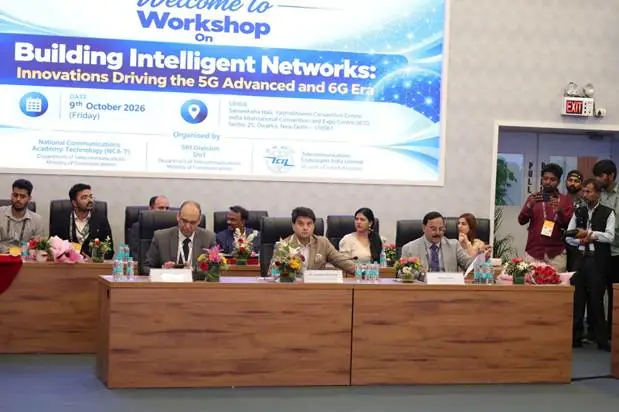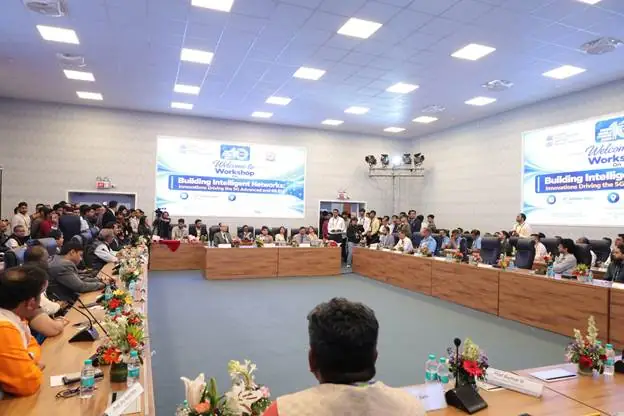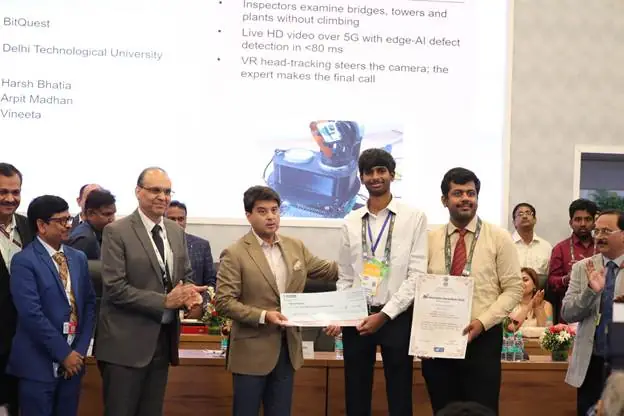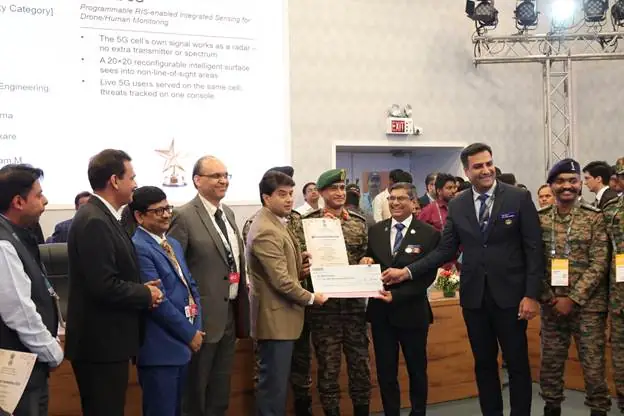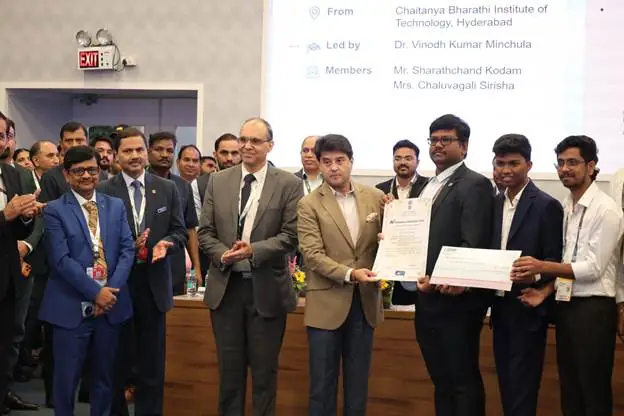
Union Minister Jyotiraditya M. Scindia on Wednesday inaugurated a workshop on 5G use-case labs at the India Mobile Congress 2026, using the platform to underscore the government's push to convert India's telecom scale into a deeper innovation ecosystem. The event, held amid growing policy focus on advanced connectivity, was framed not merely as a showcase of technology but as a testbed for how India can translate network capacity into economic and social value.
The minister's remarks placed young innovators at the centre of that transition. By spotlighting students, startups and early-stage technologists, Scindia signalled that the next phase of India's telecom story will depend less on infrastructure rollout alone and more on the ability to build applications that solve practical problems in health, education, industry and public services. The workshop on 5G use-case labs is intended to accelerate that shift by giving developers and institutions a space to experiment with low-latency, high-bandwidth applications in a controlled environment.
Innovation Beyond Networks
The emphasis on use-case labs reflects a broader policy reality: India has already made significant progress in expanding 5G networks, but the long-term economic payoff will depend on adoption across sectors. Telecom experts have repeatedly argued that network deployment by itself does not guarantee productivity gains unless businesses, universities and government agencies can build services that take advantage of the technology. In that context, the workshop serves as a bridge between policy ambition and market execution.
Scindia's framing of youth-led innovation is also strategically important. India's demographic advantage has often been cited in discussions of digital transformation, but converting that advantage into technological leadership requires institutional support, access to test infrastructure and a pathway from prototype to deployment. By elevating the role of young innovators, the minister effectively tied the telecom agenda to the country's broader startup and skilling ecosystem.
The 5G use-case lab model is especially relevant for sectors where connectivity can change operational outcomes. In manufacturing, it can support automation and remote monitoring. In healthcare, it can enable telemedicine and connected diagnostics. In education, it can improve immersive learning and access in underserved regions. For public administration, it can strengthen digital service delivery and real-time coordination. The workshop's significance lies in its attempt to move these possibilities from concept to demonstrable use cases.
6G Readiness Takes Shape
Scindia also used the occasion to point toward India's 6G vision, indicating that the country's telecom policy is already looking beyond current-generation networks. That forward-looking posture matters because 6G development is expected to be shaped by global standards, domestic research capacity and early experimentation with next-generation applications. Countries that build strong innovation pipelines now will be better positioned to influence the architecture of future networks.
India's 6G ambitions have been increasingly linked to self-reliance in telecom technology, standards participation and indigenous research. The workshop at IMC 2026 fits into that larger strategic arc by encouraging experimentation at the edge of the ecosystem, where engineers, researchers and entrepreneurs can identify what kinds of applications will matter most when the next generation of connectivity arrives. The minister's message suggested that India cannot afford to be a passive consumer of imported telecom solutions if it wants to shape the future of digital infrastructure.
The political and policy significance of the event also lies in its timing. As India seeks to deepen digital public infrastructure, expand industrial competitiveness and attract high-value technology investment, telecom innovation is increasingly viewed as a foundational enabler rather than a standalone sector. Workshops such as this one are designed to create a pipeline of ideas that can be scaled through public-private collaboration.
Youth At Policy Centre
By placing young innovators at the centre of the discussion, the government is also making a statement about the future of policy design. The telecom sector has traditionally been dominated by large operators, equipment vendors and regulators. But the rise of application-layer innovation means that smaller teams, academic institutions and startups can now shape outcomes in meaningful ways. That shift could broaden participation in India's digital economy, provided access to labs, funding and procurement pathways keeps pace.
The workshop at IMC 2026 therefore carries significance beyond the ceremonial. It reflects a policy approach that seeks to align infrastructure, innovation and human capital. If successful, the 5G use-case lab initiative could help India move from being one of the world's largest telecom markets to one of its most influential innovation hubs. The challenge now is execution: turning demonstrations into deployable solutions, and ensuring that the country's young technologists are not just observers of the 5G and 6G era, but active architects of it.