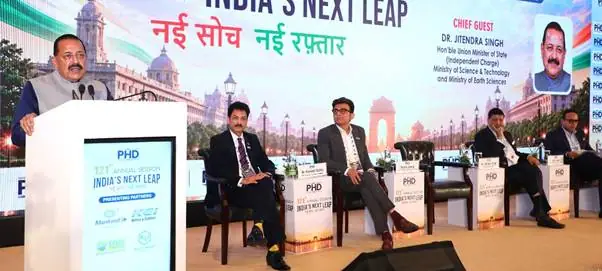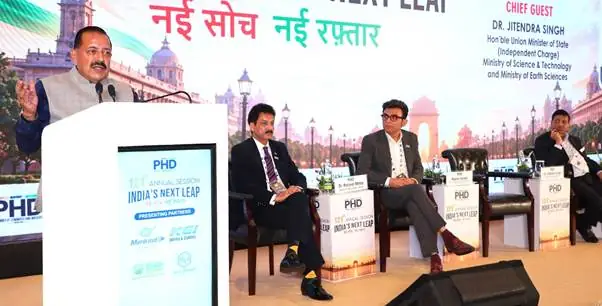
Union Minister Dr. Jitendra Singh has pressed India's industry leaders to accelerate the commercialisation of homegrown innovations and expand national capabilities that can underpin strategic sovereignty by 2047, the centenary year of Independence. The appeal reflects a broader policy shift in New Delhi: innovation is no longer being framed only as a scientific or startup issue, but as a core instrument of state capacity, industrial competitiveness, and long-term national resilience.
Speaking in the context of India's evolving innovation ecosystem, Dr. Singh's message underscored a familiar but increasingly urgent challenge. India has built a substantial base of scientific talent, public research institutions, and entrepreneurial energy, yet the conversion of laboratory breakthroughs into scalable products, industrial processes, and globally competitive technologies remains uneven. The minister's intervention signals that the government wants industry to play a more decisive role in closing this gap, particularly in sectors where strategic dependence on external suppliers can expose the country to supply-chain shocks, technology restrictions, or geopolitical pressure.
Innovation to Industry
Dr. Singh's call is significant because it places commercialisation at the centre of the innovation debate. In policy terms, this means moving beyond patents, prototypes, and pilot projects toward manufacturing, market adoption, and sustained revenue generation. For India, the ability to translate research into deployable solutions is not merely an economic objective; it is increasingly tied to national security, critical infrastructure, and technological self-reliance.
The minister's emphasis on industry suggests that the private sector is expected to become the bridge between public research and national scale. That includes investing in product development, absorbing early-stage risk, and building supply chains capable of supporting indigenous technologies. Without that bridge, even promising innovations can remain trapped in the so-called "valley of death" between discovery and commercial viability.
This message also aligns with the government's broader push to strengthen domestic manufacturing and reduce strategic vulnerabilities in areas such as advanced materials, electronics, defence-linked technologies, health innovation, and frontier science. The underlying logic is straightforward: a country that can design, produce, and export critical technologies is better positioned to protect its autonomy in a more contested global environment.
Strategic Sovereignty Goal
By linking innovation to strategic sovereignty in 2047, Dr. Singh effectively framed the next two decades as a national capability-building exercise. The phrase suggests a long horizon, but also a demanding one. India will need not only more startups and more patents, but also deeper industrial capacity, stronger public-private partnerships, and a policy environment that rewards scale, quality, and speed.
The 2047 target is especially important because it places current decisions inside a generational timeline. Investments made now in research translation, skilling, infrastructure, and regulatory reform will determine whether India enters its centenary as a technology producer or remains dependent on imported systems in key sectors. That is why the minister's remarks matter beyond the immediate event: they are a reminder that innovation policy is becoming inseparable from industrial strategy.
For industry, the message carries both opportunity and responsibility. Indian firms are being asked not only to adopt innovation, but to help shape it, finance it, and take it to market. That will require closer collaboration with universities, public laboratories, incubators, and government-backed research institutions. It will also require a stronger appetite for patient capital, since many strategic technologies take longer to mature than conventional consumer products.
Policy Meets Scale
The broader policy challenge is execution. India has repeatedly announced ambitious goals around self-reliance, deep-tech development, and innovation-led growth. The test now is whether those ambitions can be converted into measurable industrial outcomes. That means faster technology transfer, better procurement pathways for indigenous products, and a regulatory framework that supports experimentation without compromising standards.
Dr. Singh's remarks are also a signal to the private sector that the state expects a more active role in nation-building through innovation. In practical terms, that could mean greater participation in mission-driven research, co-development models, and domestic value creation. It also implies that commercial success and strategic value are no longer separate conversations; in India's current policy environment, they are increasingly the same conversation.
As India approaches 2047, the central question is not whether the country can generate ideas. It is whether it can convert those ideas into industrial strength, technological autonomy, and strategic depth. Dr. Singh's call to industry suggests that the government sees that conversion as one of the defining tasks of the coming decades.