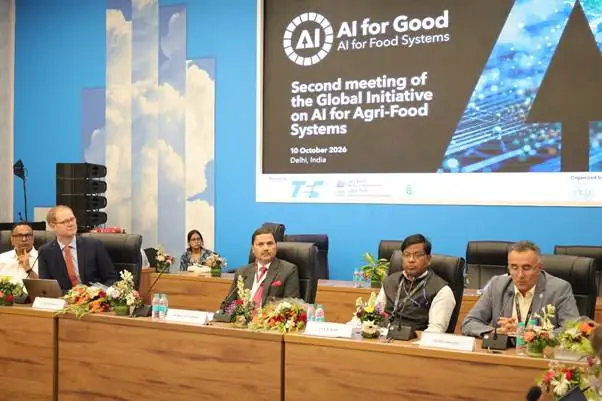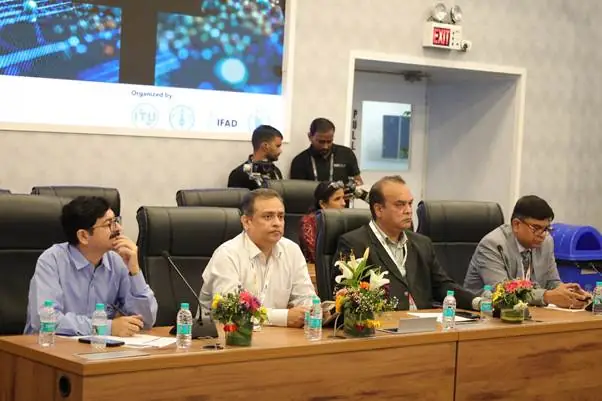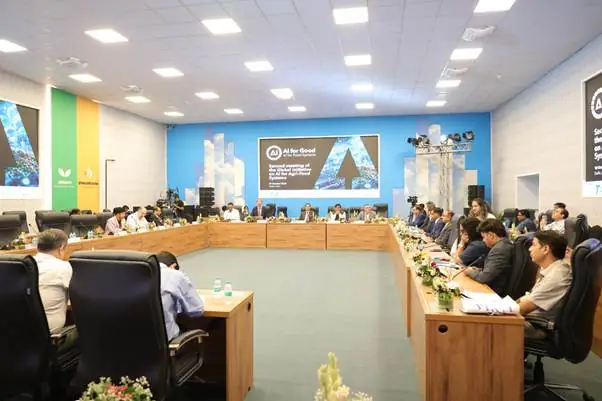
The second meeting of the Global Initiative on AI for Agricultural and Food Systems (GI-AI4FS) was convened in New Delhi during IMC 2026, placing India at the center of an emerging international debate over how artificial intelligence should be deployed in agriculture and food supply chains. The session, framed as part of a broader policy and innovation agenda, reflected growing recognition that AI is no longer a distant technological prospect for farming economies, but a practical tool that could influence crop planning, input efficiency, market access, and climate resilience.
The meeting comes at a time when governments are under pressure to reconcile two competing imperatives: accelerating digital transformation in agriculture and ensuring that technology does not deepen existing inequalities. In countries such as India, where agriculture remains a major source of livelihood and food security, the stakes are especially high. AI systems can help interpret weather patterns, detect crop stress, improve pest management, and support logistics, but the benefits depend on data quality, digital infrastructure, affordability, and farmer trust.
Policy And Practice
The GI-AI4FS platform is significant because it moves the discussion beyond abstract enthusiasm for AI and into the realm of governance. Agricultural AI is often presented as a productivity solution, but policy experts increasingly warn that without clear standards, the technology can produce fragmented results, biased outputs, or overdependence on private platforms. The New Delhi meeting therefore carries importance not only as a showcase of innovation, but as a venue for shaping rules, priorities, and international cooperation.
India's role as host is also strategically important. The country has been positioning itself as a leader in digital public infrastructure and as a voice for the Global South in technology governance. By hosting the second GI-AI4FS meeting at IMC 2026, New Delhi signaled that it wants agricultural AI to be discussed not just as a commercial opportunity, but as a public-interest instrument that must be aligned with food security, smallholder inclusion, and sustainable development.
The policy challenge is substantial. Agricultural systems are highly localized, and AI models trained on one geography may not perform well in another. That makes local data collection, multilingual interfaces, and farmer-centric design essential. At the same time, governments must consider questions of data ownership, privacy, interoperability, and accountability when AI tools are used in advisory services or decision support systems. These issues are especially sensitive in food systems, where errors can affect incomes, yields, and supply stability.
Global Food Tech Shift
The meeting also reflects a broader global shift in how food systems are being modernized. Climate volatility, labor shortages, soil degradation, and supply-chain disruptions have intensified demand for tools that can improve forecasting and resource allocation. AI is increasingly being viewed as one of the few technologies capable of integrating large, complex datasets across weather, agronomy, logistics, and markets in real time.
Yet the promise of AI in agriculture is matched by practical constraints. Many farmers still lack reliable connectivity, digital literacy, or access to affordable devices. In such settings, AI can only scale if it is embedded in extension systems, public platforms, and locally relevant service delivery models. That makes collaboration between governments, research institutions, and industry critical. It also explains why multilateral or multi-stakeholder initiatives like GI-AI4FS are gaining traction: they provide a forum to align innovation with public policy rather than leaving adoption entirely to market forces.
For India, the timing is notable. The country has been expanding digital agriculture pilots, remote advisory systems, and data-driven farm services, while also confronting the need for stronger safeguards around algorithmic decision-making. Hosting a global meeting on AI for food systems allows policymakers to project confidence in India's digital capabilities while also emphasizing that governance must keep pace with deployment.
The New Delhi meeting is unlikely to resolve all the structural questions surrounding AI in agriculture, but it does mark a clear policy signal. Governments are moving from experimentation to coordination, and from isolated pilots to broader frameworks for responsible use. As AI becomes more deeply embedded in food systems, the central issue will no longer be whether the technology can be used, but how it can be governed so that productivity gains are shared widely and risks are contained.
In that sense, the GI-AI4FS meeting at IMC 2026 was more than a conference session. It was a marker of where the global debate is heading: toward a future in which agricultural competitiveness, climate adaptation, and digital governance are increasingly treated as one interconnected policy challenge.