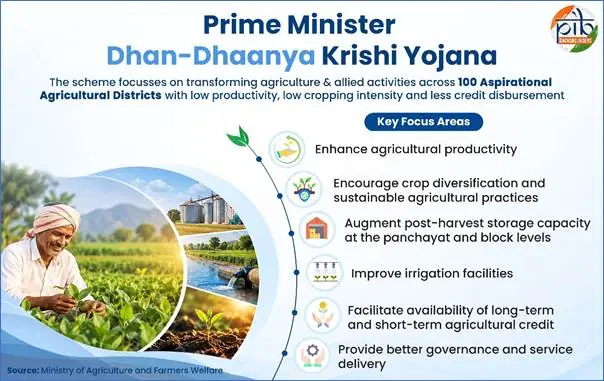
India has launched the Pradhan Mantri Dhan-Dhanya Krishi Yojana, a fresh policy instrument designed to sharpen the state's intervention in agriculture at a time when farm incomes, climate stress, and productivity gaps remain central political and economic concerns. The initiative, framed as a national governance priority, is intended to improve the efficiency of agricultural support, expand access to inputs and infrastructure, and help raise output in areas that have lagged behind the country's better-performing farm belts.
The scheme arrives against a backdrop of persistent structural challenges in Indian agriculture. While the sector still supports a large share of the population, its growth has often been uneven, with some regions benefiting from irrigation, market access, and institutional credit while others remain exposed to rain dependence, fragmented landholdings, and weak post-harvest systems. By introducing a targeted program under a nationally branded umbrella, the government appears to be signaling that it wants to move beyond broad subsidy architecture and toward more geographically focused intervention.
Targeted Farm Push
The core logic of the new program is to concentrate policy attention where it can produce measurable gains. That likely means districts or clusters with lower productivity, weaker storage and logistics, and limited access to modern farming practices. In practical terms, such an approach can help align public spending with local needs rather than distributing support too thinly across the country. For policymakers, the attraction is clear: better targeting can improve returns on investment, especially if the scheme is paired with monitoring, district-level planning, and coordination across agriculture, water, credit, and rural development departments.
The initiative also reflects a broader shift in Indian governance toward outcome-oriented welfare and development programs. Instead of relying solely on universal or heavily subsidized inputs, the state is increasingly trying to link support to specific bottlenecks. In agriculture, those bottlenecks are often not limited to seeds or fertilizer. They include irrigation reliability, soil health, extension services, warehouse capacity, cold-chain access, and the ability of farmers to sell produce without distress. A scheme built around these constraints could, if executed well, improve both productivity and bargaining power for cultivators.
Policy Meets Rural Reality
The political significance of the program is substantial. Agriculture remains one of the most sensitive sectors in Indian public life, shaping rural livelihoods, inflation trends, and electoral outcomes. Any new farm initiative is therefore read not only as a development measure but also as a statement of intent about how the government intends to manage rural discontent and economic stress. By placing a new scheme at the center of its policy narrative, the administration is effectively acknowledging that the farm economy still requires active state support, even as it seeks to modernize the sector.
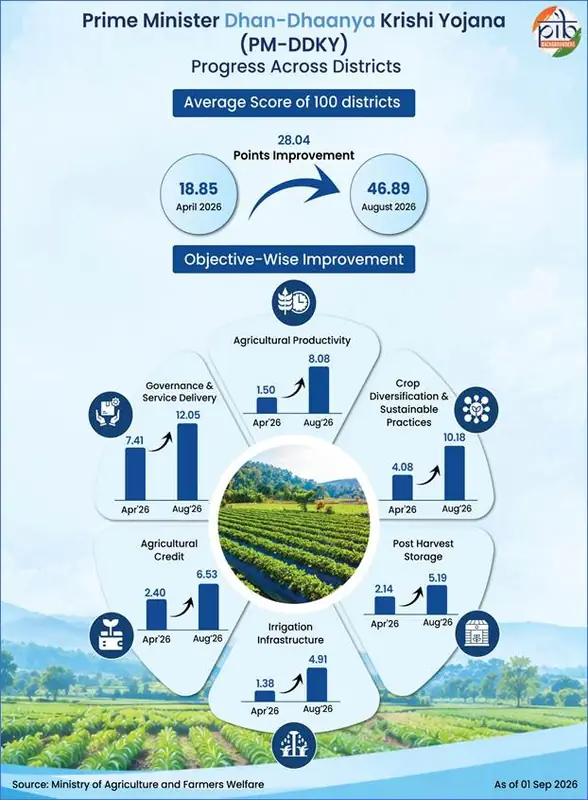
Yet the success of the program will depend less on its branding than on implementation. India has a long record of ambitious agricultural schemes that struggled to deliver because of fragmented execution, weak coordination, or limited local capacity. If the new initiative is to avoid that fate, it will need clear eligibility rules, transparent fund flows, measurable district benchmarks, and a credible mechanism for tracking outcomes such as yield improvement, water efficiency, credit penetration, and post-harvest loss reduction. Without those safeguards, the scheme risks becoming another layer in an already crowded policy landscape.
The timing is also important. Indian agriculture is under pressure from erratic weather patterns, rising input costs, and the need to adapt to changing market conditions. Farmers are being asked to produce more with less water, less land security, and greater exposure to climate volatility. A program that genuinely strengthens resilience could help bridge the gap between policy ambition and rural reality. But if it is to matter, it must move beyond announcements and into the harder work of delivery.
What Comes Next
For now, the Pradhan Mantri Dhan-Dhanya Krishi Yojana stands as a significant signal of intent: a recognition that agricultural growth remains central to India's development story and that uneven rural progress cannot be left to market forces alone. The challenge for the government will be to ensure that the scheme becomes a practical instrument for raising productivity and incomes, rather than a symbolic addition to the long list of farm programs.
If the rollout is disciplined and data-driven, the initiative could become an important test case for how India targets public investment in agriculture. If not, it may simply underscore how difficult it remains to translate national policy ambition into durable gains for farmers on the ground.