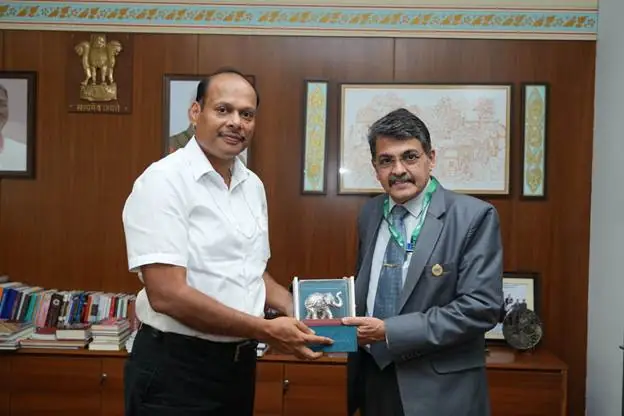
Hindustan Aeronautics Limited, the National Culture Fund and the Archaeological Survey of India have signed a memorandum of agreement to support the conservation and development of heritage sites, marking a notable convergence of industrial public enterprise, cultural financing and archaeological governance. The pact is being viewed as part of a wider effort to expand the institutional and financial architecture around heritage preservation at a time when many historic sites face pressure from weathering, urbanisation, visitor load and uneven maintenance.
Heritage Funding Model
The agreement underscores a policy approach that increasingly relies on partnerships rather than public funding alone. In India, the conservation of monuments and archaeological sites is typically led by the ASI, but the scale of need often exceeds the resources available through routine government allocations. By involving the National Culture Fund, which is designed to mobilise support for cultural projects, the arrangement creates a channel through which additional funding and technical collaboration can be directed toward preservation work.
HAL's participation is especially notable because it reflects the role that public-sector undertakings can play beyond their core industrial mandates. Such participation can help bridge the gap between heritage needs and available state capacity, particularly for projects that require restoration expertise, visitor infrastructure, landscaping, interpretation systems or long-term upkeep. The agreement also fits a broader trend in which state-owned enterprises are being encouraged to contribute to social and cultural development through structured institutional mechanisms.
ASI's Conservation Mandate
For the Archaeological Survey of India, the pact reinforces its central role as the custodian of the country's protected monuments and archaeological heritage. The ASI is responsible not only for preservation but also for ensuring that interventions remain historically sensitive, scientifically grounded and compliant with conservation norms. Any partnership of this kind must therefore balance development ambitions with strict heritage safeguards.
That balance is crucial. Heritage projects can easily become contentious if restoration is seen as excessive, commercialised or detached from the original character of a site. The involvement of the ASI helps ensure that conservation remains the primary objective, while development is framed as a means of improving access, interpretation and long-term sustainability rather than altering the historic fabric of the site.
The agreement also arrives at a moment when heritage policy is increasingly tied to public engagement. Well-maintained sites can support education, tourism and local economic activity, but only if conservation is handled with discipline. The challenge for any such initiative is to preserve authenticity while making sites more resilient and accessible.
Broader Policy Signal
The memorandum carries significance beyond the immediate projects it may support. It reflects a governance model in which cultural preservation is no longer treated solely as a narrow archaeological function, but as a shared public responsibility involving multiple institutions. That approach can be especially useful in a country with a vast and diverse heritage inventory, where the demands of preservation often outstrip the capacity of any single agency.
It also highlights the growing importance of formalised agreements in public policy. Memoranda of agreement provide a framework for accountability, roles and implementation, which is essential when multiple institutions with different mandates are involved. In heritage work, such clarity can determine whether a project becomes a durable conservation success or a fragmented intervention.
The timing of the pact is also politically and administratively relevant. Heritage conservation has become an increasingly visible part of the national development conversation, linked not only to cultural identity but also to tourism, urban planning and soft power. By bringing together a major public-sector company, a culture-focused fund and the ASI, the agreement suggests that the government is seeking more integrated and scalable ways to protect historic assets.
While the specific sites and project timelines were not immediately detailed, the significance of the agreement lies in its institutional design. It points to a model in which conservation is financed more creatively, executed more collaboratively and governed more carefully. For India's heritage sector, that may prove as important as any single restoration project.