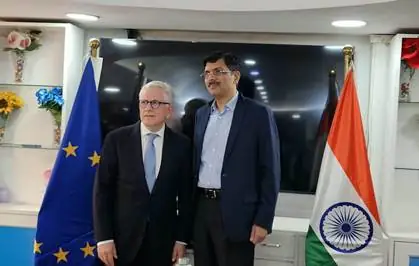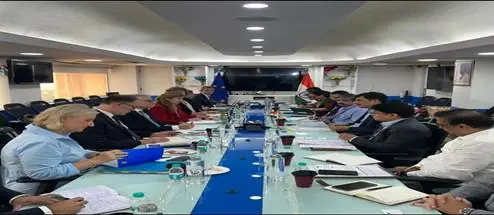
India's Power Secretary met Gerassimos Thomas, the European Commission's Director-General for Taxation and Customs Union, in New Delhi on Tuesday in a bilateral engagement that reflects the widening scope of India-EU policy dialogue beyond traditional trade issues. While the meeting was framed around institutional engagement, it comes at a moment when customs administration, taxation rules, and cross-border regulatory alignment are increasingly central to economic diplomacy between major markets.
Policy Dialogue Expands
The meeting signals the Indian government's continuing effort to maintain active channels with European institutions on issues that affect commerce, investment, and industrial planning. For India, the European Union remains one of its most important economic partners, and discussions with senior officials from Brussels often extend into areas that shape market access, compliance costs, and the movement of goods across borders. A meeting involving the head of the power ministry's administrative leadership and the EU's top customs and tax official suggests that energy-sector supply chains and broader industrial trade considerations may have been part of the conversation, even if the official readout remains limited.
Such engagements have gained importance as governments worldwide reassess the balance between trade openness and regulatory oversight. For India, customs procedures and tax architecture are not merely fiscal tools; they are also instruments that influence manufacturing competitiveness, import dependence, and the pace of infrastructure build-out. For the European Union, the taxation and customs portfolio is closely tied to enforcement, border efficiency, and the implementation of trade rules across a bloc of 27 member states.
Trade And Compliance Stakes
The bilateral meeting comes against a backdrop of intensifying India-EU economic engagement, including discussions on trade facilitation, standards, and the future of supply chains. As India seeks to expand domestic manufacturing and attract higher-quality foreign investment, predictable customs administration and transparent tax processes are increasingly relevant to European firms operating in sectors ranging from energy equipment to advanced industrial goods.
The power sector, in particular, depends on a wide ecosystem of imported components, capital equipment, and technology transfers. Even when a meeting is not explicitly about energy policy, the presence of India's Power Secretary in a dialogue with the EU's tax and customs chief points to the practical reality that electricity infrastructure, grid modernization, and clean-energy deployment are deeply connected to trade logistics and border procedures. Delays, duties, or compliance uncertainty can affect project timelines and costs, especially in capital-intensive sectors.
For the European side, engagement with Indian officials also serves a strategic purpose. The EU has been working to strengthen economic ties with India while protecting the integrity of its regulatory framework. Customs cooperation and tax coordination can help reduce friction in trade flows, improve enforcement against evasion, and support more efficient movement of legitimate goods. These are not abstract concerns; they are central to the functioning of modern trade relationships.
Strategic Economic Signaling
Although no formal outcome from the meeting has been publicly detailed, the optics are significant. High-level bilateral conversations of this kind often serve as confidence-building mechanisms, allowing both sides to identify bottlenecks and explore areas where administrative cooperation can be improved without requiring immediate treaty-level commitments. In the current global environment, where supply chains remain vulnerable and governments are under pressure to secure resilient industrial ecosystems, even technical meetings can carry strategic weight.
The engagement also reflects India's broader diplomatic approach of combining sector-specific governance with external economic outreach. By hosting senior European officials in New Delhi, the government reinforces the message that India is open to structured dialogue on the rules that govern trade and investment. That is especially relevant as India continues to position itself as both a large consumer market and a manufacturing base for global firms.
The meeting between the Power Secretary and Gerassimos Thomas therefore fits into a larger pattern of pragmatic, issue-based diplomacy. Rather than focusing solely on headline trade negotiations, both sides appear to be investing in the administrative and regulatory foundations that determine whether economic partnerships can scale. In that sense, the conversation in New Delhi was less about symbolism than about the mechanics of cooperation — the kind that often shapes outcomes long before any formal agreement is announced.