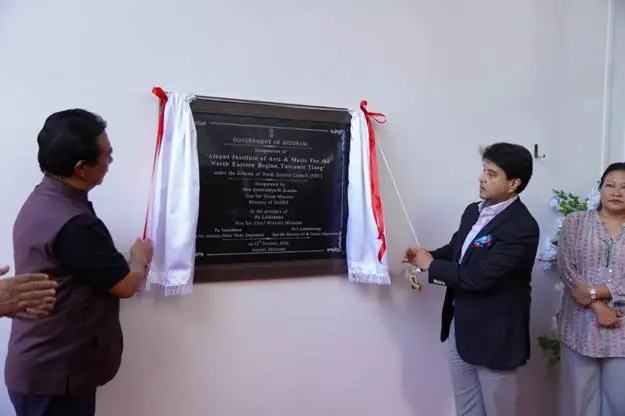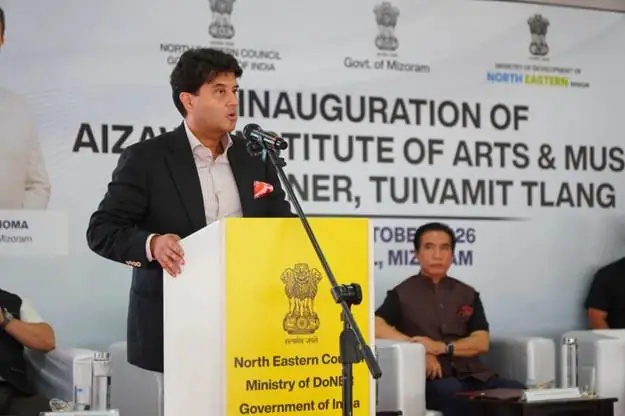
Union Minister Jyotiraditya M. Scindia on Tuesday inaugurated and laid the foundation stone for development projects worth ₹331 crore in Mizoram, in a move that highlights the Centre's continuing emphasis on infrastructure-led governance in the Northeast. The projects, announced during his visit to the state, are part of a broader policy approach that seeks to close long-standing development gaps in remote and geographically challenging regions through targeted public investment.
The package spans both completed and upcoming works, signaling a dual-track strategy: deliver visible assets quickly while also building the institutional and physical foundations for longer-term growth. While the specific components of the projects were not immediately detailed in the available information, the scale of the investment suggests a mix of civic, connectivity, and administrative infrastructure designed to improve everyday governance and public access in Mizoram.
Northeast Push
The announcement comes at a time when the Union government has been trying to deepen its footprint in the Northeast through roads, communications, digital access, and public-sector expansion. Mizoram, with its difficult terrain and dispersed settlements, has historically faced higher costs of infrastructure creation and slower service delivery than many mainland states. In that context, a ₹331 crore allocation is not merely a ceremonial figure; it reflects the Centre's attempt to translate policy rhetoric into tangible assets in a region where logistics and geography often determine the pace of development.
Scindia's presence at the inauguration also carries political and administrative significance. As a senior Union minister, his visit signals direct central engagement with state-level development priorities. Such visits are often used to demonstrate coordination between the Union and state governments, especially in regions where infrastructure remains a key determinant of economic integration and public trust.
The Northeast has become increasingly central to India's strategic and economic planning. Beyond the immediate benefits to local residents, investments in Mizoram also serve wider national interests, including border-area development, internal connectivity, and the strengthening of supply chains that link the region more effectively with the rest of the country. In that sense, the projects are part of a larger state-building effort rather than isolated capital works.
Infrastructure As Policy
The emphasis on inaugurations and foundation stones is also politically meaningful. In Indian governance, such events are often used to mark the transition from announcement to execution, a distinction that matters in regions where project delays have historically eroded public confidence. By combining completed works with new foundations, the government is seeking to project continuity, momentum, and administrative seriousness.
For Mizoram, the practical impact will depend on timely implementation, contractor performance, and coordination with local authorities. In remote states, the success of development spending is often determined less by headline allocations than by execution quality, maintenance planning, and the ability to adapt projects to terrain and weather constraints. That makes the monitoring of these works as important as their launch.
The projects also fit into a broader national policy narrative that places special weight on balanced regional development. Successive central governments have framed the Northeast as a priority zone for infrastructure, connectivity, and public investment, both to reduce economic isolation and to reinforce integration with national markets. The latest tranche in Mizoram suggests that this approach remains active and politically salient.
Strategic Significance
Mizoram's location gives such investments added importance. As a border state with limited transport corridors and a relatively small but geographically dispersed population, it depends heavily on public infrastructure to improve mobility, administrative reach, and access to services. Development projects in such a setting can have outsized effects, improving not only local quality of life but also the state's ability to attract private activity and sustain public delivery.
At the same time, the announcement serves as a reminder that infrastructure spending in the Northeast is as much about governance as it is about construction. Roads, buildings, and public facilities are the visible end products, but the deeper objective is to make the state more connected, more administratively capable, and less vulnerable to the structural disadvantages of remoteness.
The ₹331 crore package, therefore, should be read as part of a larger policy architecture rather than a standalone event. It reflects the Centre's continuing effort to use capital expenditure as a tool of regional inclusion, with Mizoram positioned as one of the beneficiaries of that strategy. The real test will come in the months ahead, when the pace of implementation reveals whether the promise of development can be matched by delivery on the ground.