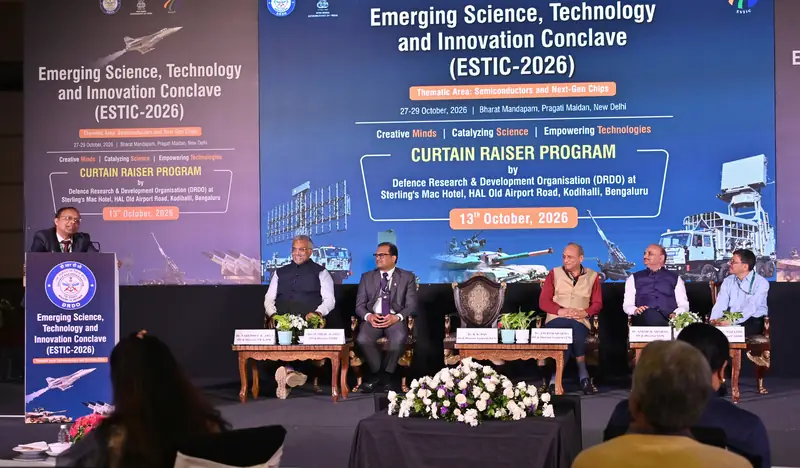
India's Defence Research and Development Organisation is set to host a special session on semiconductors and next-generation chips at ESTIC-2026, a move that places advanced electronics squarely within the country's defence and technology policy agenda. The session is expected to draw attention to the strategic importance of chip design, fabrication, packaging and supply-chain resilience at a time when semiconductors have become a defining input for both military readiness and economic competitiveness.
The decision to spotlight semiconductors at a defence-linked technology forum is significant because it reflects a broader shift in how India is framing industrial capability. Chips are no longer viewed merely as components for consumer electronics; they are now foundational to radar systems, secure communications, autonomous platforms, space applications, precision-guided systems and a wide range of dual-use technologies. For a country seeking greater self-reliance in critical systems, the ability to access and eventually produce advanced chips is increasingly seen as a strategic necessity rather than an optional industrial ambition.
Strategic Chip Priorities
The special session is likely to serve as a platform for discussing the technological gaps that continue to constrain India's semiconductor ecosystem, including dependence on imported fabrication capacity, limited domestic access to cutting-edge process nodes, and the need for stronger design-to-manufacturing linkages. While India has developed a growing base in chip design talent, the country still relies heavily on overseas foundries and global supply chains that are vulnerable to geopolitical shocks, export controls and market concentration.
For the defence establishment, those vulnerabilities carry particular weight. Modern weapons platforms and surveillance systems increasingly depend on highly specialised chips that must meet stringent performance, reliability and security standards. Any disruption in supply can affect timelines, costs and operational preparedness. A dedicated session hosted by DRDO suggests that the organisation is seeking to align research priorities with the broader national semiconductor mission, while also identifying areas where defence requirements can help shape domestic innovation.
The timing also matters. Global semiconductor competition has intensified as major economies race to secure supply chains, subsidise domestic manufacturing and reduce dependence on a small number of production hubs. India has entered that contest with policy incentives, public-private partnerships and a stated ambition to build a more resilient electronics manufacturing base. Yet the challenge remains formidable: establishing a competitive semiconductor ecosystem requires sustained investment, technical depth, skilled labour, clean-room infrastructure, and long-term policy continuity.
Defence Meets Deep Tech
DRDO's involvement gives the ESTIC-2026 session a distinctly strategic dimension. Unlike general industry conferences, a defence research institution can frame chip development around mission-critical use cases such as secure hardware, radiation-hardened components, embedded systems and trusted supply chains. That perspective may help bridge the gap between academic research, startup innovation and industrial scale-up, which has often slowed India's progress in advanced electronics.
The session is also likely to reinforce the government's broader message that technology sovereignty is inseparable from national security. In sectors such as aerospace, missile systems, electronic warfare and encrypted communications, dependence on foreign suppliers can create operational risks that extend beyond economics. By elevating semiconductors within a defence research forum, authorities are signalling that chip capability is now part of the country's strategic infrastructure.
At the same time, expectations should remain measured. A special session does not by itself solve the structural barriers facing India's semiconductor ambitions. The country still needs deeper coordination between ministries, research laboratories, private firms and state governments, along with a clearer pathway from design excellence to commercial manufacturing. The real test will be whether discussions at ESTIC-2026 translate into durable programmes, procurement commitments and ecosystem-building measures.
Policy Signal, Not Just Showcase
Even so, the announcement is an important policy signal. It indicates that the semiconductor agenda is moving beyond generic industrial promotion and into the realm of national capability planning. That shift could prove consequential if it leads to stronger demand signals from defence procurement, more targeted support for chip-related research, and greater integration between India's innovation ecosystem and its strategic requirements.
For India, the stakes are high. Semiconductors sit at the intersection of economic growth, digital infrastructure and military preparedness. A country that can design, secure and eventually manufacture more of its own advanced chips will be better positioned to protect supply chains, support domestic industry and reduce exposure to external pressure. DRDO's planned session at ESTIC-2026 suggests that policymakers increasingly understand that reality — and are beginning to treat chips as a core national asset rather than a peripheral technology issue.