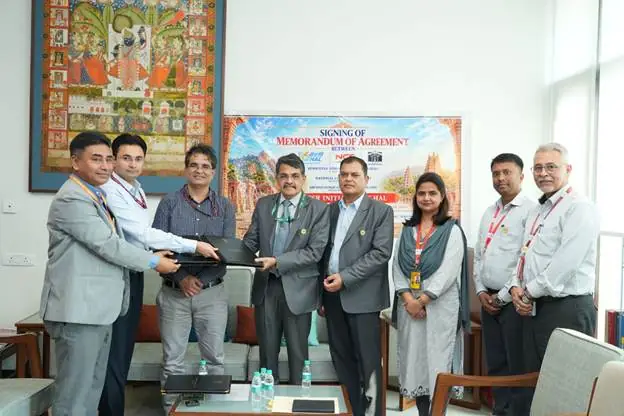
Hindustan Aeronautics Limited (HAL), the National Culture Fund (NCF) and the Archaeological Survey of India (ASI) have entered into a memorandum of agreement aimed at strengthening the conservation and development of heritage sites, marking a notable convergence of industrial public enterprise, cultural stewardship and state-led preservation policy.
The agreement is significant not only for what it promises to fund, but for the institutional model it represents. In a country where heritage conservation often competes with infrastructure pressure, urban expansion and limited public budgets, the arrangement signals a more structured attempt to mobilize non-traditional resources for preservation. By bringing HAL into the framework, the initiative reflects the growing expectation that large public-sector undertakings can contribute to national cultural priorities beyond their core industrial mandates.
Heritage Funding Model
The National Culture Fund was created to channel financial and institutional support into cultural preservation projects, often by drawing on partnerships with public and private entities. Its role in this agreement is central: it provides the mechanism through which conservation support can be organized, monitored and aligned with official heritage priorities. The ASI, as the statutory authority responsible for archaeological sites and monuments of national importance, will anchor the technical and regulatory side of the effort.
For HAL, the agreement extends the company's public role into the cultural domain. As one of India's most prominent defence and aerospace enterprises, HAL is frequently associated with strategic manufacturing and national security. Its participation in a heritage conservation pact underscores a broader policy trend in which state-owned companies are increasingly encouraged to contribute to social, educational and cultural infrastructure as part of their public responsibility.
The practical value of the MoA will depend on how the three institutions translate the agreement into site-level action. Heritage conservation is rarely a matter of symbolic commitment alone. It requires structural repair, scientific restoration, visitor management, documentation, landscape treatment and long-term maintenance. Development, in this context, must be understood carefully: if handled well, it can improve access, interpretation and sustainability; if handled poorly, it can risk over-commercialization or damage to the authenticity of protected sites.
Policy Signal For PSUs
The agreement also carries a wider policy message for public-sector governance. India has increasingly relied on corporate social responsibility frameworks, trust-based funding and public-private collaboration to supplement state capacity in sectors where the public good is clear but fiscal room is constrained. Heritage conservation fits squarely within that logic. It is a public function, but one that often benefits from diversified financing and institutional partnerships.
This is especially relevant at a time when India is seeking to balance rapid development with the preservation of its historical identity. Heritage sites are not only cultural assets; they are also economic assets that support tourism, local employment and place-based development. Conservation can therefore have multiplier effects, but only if it is guided by professional standards and long-term planning rather than short-term visibility.
The ASI's involvement is crucial because it ensures that the agreement remains within the legal and conservation framework governing protected monuments and archaeological sites. That matters in a sector where well-intentioned interventions can become problematic if they are not aligned with preservation norms. The presence of the NCF adds an additional layer of institutional discipline, potentially helping to ensure that funding is directed toward measurable conservation outcomes.
Broader Heritage Stakes
The MoA arrives at a moment when India's heritage sector faces a familiar challenge: how to preserve a vast and diverse archaeological legacy while also making sites more accessible, better maintained and more resilient to environmental and human pressures. Many monuments require not just emergency repair but sustained conservation planning, scientific documentation and visitor infrastructure that does not compromise historical integrity.
In that sense, the agreement between HAL, NCF and ASI is more than a ceremonial partnership. It is part of a larger effort to build a financing and governance architecture for heritage that can endure beyond individual projects. If implemented effectively, it could serve as a template for similar collaborations involving other public enterprises and cultural institutions.
The test, however, will be execution. Heritage agreements often generate optimism at the signing stage, but their value is ultimately measured in restored structures, protected landscapes and improved site management. For now, the MoA represents an important institutional commitment: a recognition that preserving India's past is not separate from the work of the modern state, but an essential part of it.