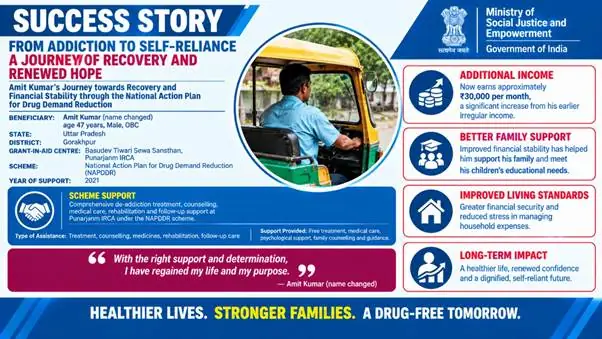
India's approach to substance-use disorder is undergoing a quiet but consequential shift. What was once framed largely as a law-and-order problem is now being discussed more openly as a public health, social welfare, and economic reintegration challenge. The new emphasis is not only on helping people stop using drugs or alcohol, but on enabling them to rebuild their lives with skills, support systems, and access to work.
This change matters because addiction rarely exists in isolation. It is often tied to unemployment, family distress, mental health pressures, homelessness, and social exclusion. For policymakers, that means recovery cannot be treated as a single intervention. It requires a chain of support: detoxification, counseling, community-based care, vocational training, and follow-up services that reduce the risk of relapse. In that sense, the policy goal is no longer merely abstinence. It is self-reliance.
Recovery as Public Policy
The most important shift is conceptual. India's governance framework is increasingly recognizing that people recovering from addiction need more than clinical treatment. They need a credible route back into society. That includes access to education, job placement, family mediation, and local support networks that can sustain recovery after formal treatment ends.
This is especially relevant in a country where the burden of substance use is spread unevenly across regions and communities. Urban centers face heroin, synthetic drugs, and alcohol-related harm, while rural and semi-urban areas often struggle with locally available intoxicants and weak treatment access. A one-size-fits-all response has repeatedly fallen short. The policy response now being favored is more layered: prevention for vulnerable groups, treatment for those already affected, and rehabilitation for those ready to re-enter the workforce.
The language of self-reliance is also politically significant. It aligns addiction recovery with broader national priorities around productivity, social inclusion, and human capital. A person who completes treatment and returns to stable employment is not only a beneficiary of welfare; they become an active participant in the economy. That framing helps move the issue away from stigma and toward measurable social recovery.
Treatment Beyond Detox
Experts have long warned that detox alone is not recovery. Without psychological support and post-treatment engagement, relapse remains a major risk. That is why rehabilitation models increasingly stress continuity of care. The most effective systems combine medical supervision with counseling, peer support, and structured reintegration plans.
For India, this is a governance test. Public systems must coordinate across health departments, social welfare agencies, local administrations, and employment-linked institutions. The challenge is not just building treatment capacity, but making sure people do not fall through the cracks after discharge. If a recovering person returns to the same environment without support, the odds of sustained recovery decline sharply.
There is also a stigma problem. Many families hide addiction until the crisis becomes severe, delaying treatment and increasing harm. Public messaging that treats recovery as possible, normal, and socially valuable can improve early intervention. It can also encourage employers and communities to see recovery not as a liability, but as a second chance.
Building A Second Chance
The deeper policy opportunity lies in linking recovery to livelihood. Skills training, apprenticeships, and placement support can turn rehabilitation into a genuine economic pathway. For many recovering individuals, the ability to earn again is what stabilizes treatment gains. Income restores routine, dignity, and a sense of purpose — all of which are protective factors against relapse.
This is where the idea of "new hope" becomes more than rhetoric. It signals a model of governance that measures success not only by reduced substance use, but by restored lives. That includes safer families, lower social costs, and stronger community resilience. In practical terms, it means addiction policy must be designed as a long-term investment in people, not a short-term enforcement campaign.
The broader lesson is clear. India's response to addiction will be judged not by how forcefully it reacts to misuse, but by how effectively it helps people recover, work, and live independently again. In that sense, the country's emerging recovery agenda is as much about economic citizenship as it is about health. The real test is whether the system can turn treatment into transformation.