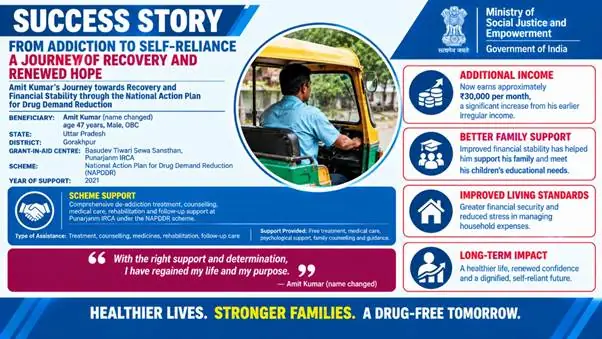
India's evolving approach to substance-use recovery is moving beyond the narrow language of treatment and toward a more ambitious policy objective: restoring autonomy, dignity, and economic participation to people in recovery. In a country where addiction intersects with unemployment, family distress, mental health, and social stigma, the policy challenge is no longer simply how to help individuals stop using drugs or alcohol, but how to ensure they can rebuild stable lives afterward.
Recovery Beyond Detox
The central shift is conceptual as much as operational. For years, addiction policy in India has often been discussed in terms of enforcement, de-addiction camps, and episodic medical intervention. That model, while necessary in acute cases, has repeatedly shown its limits when recovery is not followed by structured rehabilitation. The new emphasis on self-reliance reflects a more durable understanding: sobriety is not an endpoint but a transition that must be supported through counseling, skill development, family engagement, and access to work.
This framing matters because relapse risk rises sharply when people leave treatment and return to the same social and economic conditions that contributed to dependency in the first place. Without income, routine, and a sense of purpose, recovery can remain fragile. Policymakers are therefore increasingly treating rehabilitation as part of the broader governance agenda, not merely a health-sector function.
The language of self-reliance also aligns with India's wider policy vocabulary, which has increasingly emphasized empowerment over dependency. In the addiction context, that means helping individuals regain control over their daily lives, rebuild confidence, and re-enter society as productive citizens. The message is clear: recovery must create capability, not just abstinence.
Policy Meets Livelihoods
The strongest recovery models are those that connect treatment to livelihoods. Across India, rehabilitation efforts are gaining traction when they include vocational training, job placement support, peer mentoring, and community-based follow-up. These measures recognize that a person emerging from addiction often faces a double burden: the physiological challenge of recovery and the social challenge of reintegration.
This is where governance becomes decisive. A fragmented system can leave patients moving from one facility to another without continuity of care. A more integrated model, by contrast, links hospitals, counseling centers, local administrations, and employment pathways. That integration is essential in a country of India's scale, where access to care remains uneven between urban and rural areas, and where stigma can be as disabling as the addiction itself.
Public policy experts increasingly argue that addiction should be treated as a development issue as well as a medical one. Families affected by substance dependence often face financial instability, school dropout, domestic conflict, and reduced productivity. When recovery succeeds, the benefits extend well beyond the individual. Households stabilize, local labor participation improves, and pressure on welfare and health systems can ease over time.
The challenge, however, is implementation. India's addiction-response ecosystem remains uneven, with gaps in trained personnel, aftercare infrastructure, and community-level outreach. The most effective programs are those that do not end at discharge. They maintain contact, monitor progress, and provide practical support during the vulnerable months after treatment.
Stigma Still Shapes Outcomes
Even where services exist, stigma remains one of the most persistent barriers to recovery. Many people delay seeking help because addiction is still widely viewed as a moral failing rather than a treatable condition. That perception can isolate individuals, discourage families from engaging with care, and reduce the likelihood that employers will offer a second chance.
A recovery framework built around self-reliance can help counter that stigma, but only if it is paired with compassion and evidence-based care. The goal is not to romanticize individual willpower. It is to create systems that make recovery sustainable. That requires public messaging that normalizes treatment, institutional practices that protect dignity, and local support structures that prevent people from falling back into isolation.
For India's governance apparatus, the broader lesson is straightforward: addiction recovery cannot be managed as a one-time intervention. It must be treated as a continuum that begins with treatment and extends into reintegration. The policy test is whether a person leaving care can realistically return to work, family life, and social participation with the support needed to stay on course.
In that sense, the shift from addiction to self-reliance is more than a slogan. It is a measure of whether the state can help transform vulnerability into stability, and treatment into lasting independence. For a country seeking stronger human capital and more inclusive growth, that transformation is not peripheral. It is central.