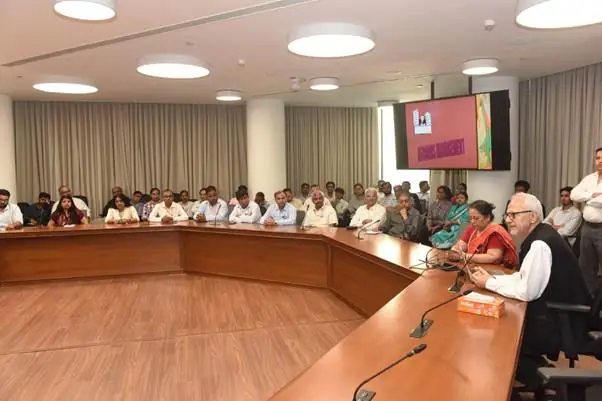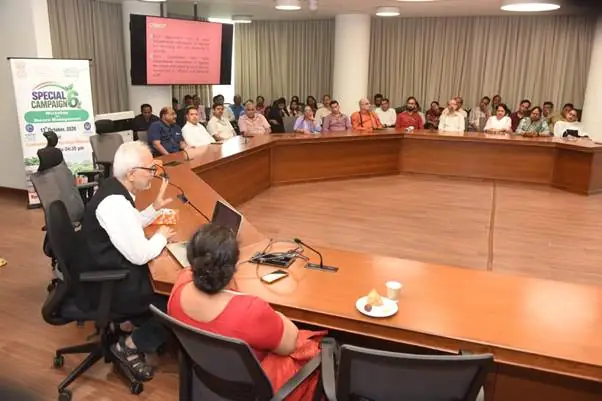
The Legislative Department has conducted a workshop on records management as part of Special Campaign 6, placing renewed emphasis on one of the most basic but consequential functions of government: how official records are created, stored, retrieved, and preserved. While such exercises may appear procedural, they sit at the core of administrative performance, especially in a system where large volumes of correspondence, legal drafts, policy notes, and statutory materials must remain accessible and auditable over time.
Records as Governance
The workshop comes at a time when the Union government has been steadily using special campaigns to push departments toward better housekeeping, reduced pendency, and more disciplined record handling. In a ministry or department such as the Legislative Department, records management is not merely an internal clerical matter. It directly affects the quality of legislative drafting, continuity in legal interpretation, institutional memory, and the speed with which officials can respond to queries, references, and inter-ministerial consultations.
For a department that serves as a key legal and drafting arm of the government, the integrity of records has wider implications. Poorly maintained files can slow down decision-making, create duplication of work, and increase the risk of inconsistency in official positions. By contrast, structured record management supports transparency, enables easier retrieval of precedent, and strengthens the reliability of the administrative process. The workshop therefore signals an effort to reinforce the documentary backbone of governance rather than treat records as a back-office afterthought.
Campaign For Administrative Discipline
Special Campaign 6 appears to be part of a continuing administrative reform framework that encourages departments to identify bottlenecks, improve workplace systems, and promote measurable efficiency gains. In practice, such campaigns often combine cleanliness drives, disposal of obsolete material, digitization efforts, and training on file management. The Legislative Department's workshop fits squarely within that model, suggesting an attempt to build habits of compliance and standardization among officials who handle sensitive and high-value documentation.
The timing is also significant. Across government, there is growing recognition that records management must evolve beyond paper-heavy routines. Digital workflows, e-office systems, and electronic archiving have changed expectations around speed and traceability. Yet the transition is uneven, and many departments still depend on hybrid systems that require careful coordination between physical and digital records. Workshops of this kind help close that gap by reminding officials that modernization is not only about technology, but also about process discipline and staff training.
Why It Matters Now
The importance of records management has increased as public administration becomes more data-driven and more accountable to audit, parliamentary scrutiny, and legal review. In the legislative sphere, where drafting histories and file notes can shape future policy interpretation, the preservation of records is essential. A well-managed archive can support continuity across leadership changes, reduce dependence on individual memory, and provide a defensible trail of administrative reasoning.
The workshop also reflects a broader governance message: efficiency begins with systems. Governments often announce ambitious reforms in policy and service delivery, but those reforms depend on the quality of internal administration. If records are incomplete, misfiled, or inaccessible, even strong policy intent can be undermined by operational friction. By focusing on records management, the Legislative Department is addressing a foundational issue that affects both internal functioning and public accountability.
Although the workshop itself is a procedural event, it carries symbolic weight. It shows that the government continues to invest in the less visible mechanics of administration, where gains may not be dramatic but are often durable. In an era of rapid digitization and rising expectations for responsiveness, the ability to manage records efficiently is increasingly a marker of institutional maturity. Special Campaign 6, in this sense, is not just about tidying files; it is about strengthening the administrative architecture that supports lawmaking, governance, and continuity of the state.