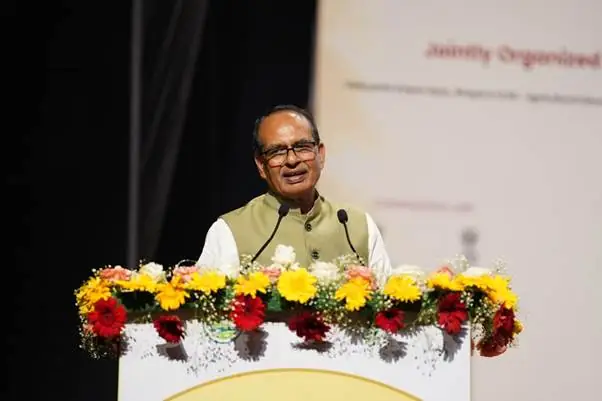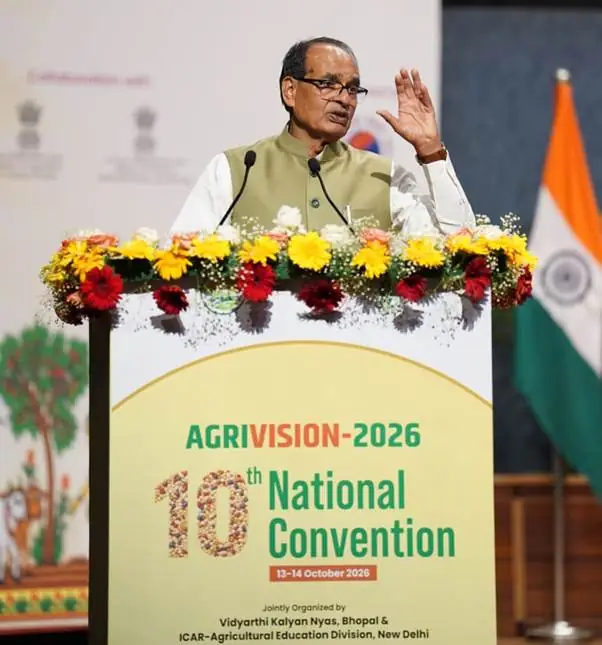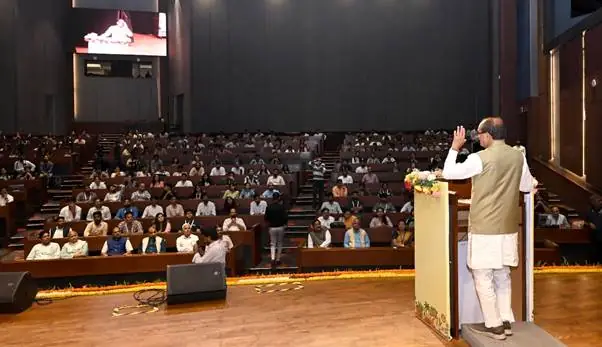
Union Agriculture and Farmers' Welfare and Rural Development Minister Shivraj Singh Chouhan participated in the 10th national convention of AgriVision in New Delhi, using the platform to reinforce the centrality of agriculture in India's development agenda. The appearance comes at a time when the government is seeking to balance immediate farmer concerns with longer-term structural reforms aimed at improving productivity, resilience, and rural incomes.
The convention, held in the national capital, brought attention to the policy and business dimensions of Indian agriculture, a sector that remains both economically vital and politically sensitive. With millions of livelihoods tied to farming and allied activities, any national discussion on agriculture inevitably extends beyond crop output to issues such as market access, input costs, irrigation, technology adoption, and the sustainability of rural employment.
Policy Priority Signal
Chouhan's participation is being read as a signal that the government intends to keep agriculture near the top of its policy agenda. As the minister responsible for both agriculture and rural development, his presence at an industry-facing convention reflects the administration's effort to align farm policy with broader rural transformation. That alignment is increasingly important as India navigates uneven monsoons, climate-linked production risks, and pressure to raise farm incomes without distorting markets.
The agricultural sector has also become a focal point for the government's wider growth strategy. While India's services and manufacturing sectors often dominate macroeconomic debate, agriculture continues to anchor consumption in large parts of the country and remains a critical buffer in periods of economic stress. Any policy message delivered from a national convention therefore carries significance for farmers, agribusiness stakeholders, and state-level administrators alike.
Rural Economy At Center
The dual portfolio held by Chouhan gives added weight to the policy conversation. Agriculture and rural development are increasingly being viewed as interconnected rather than separate domains: farm productivity affects rural incomes, while rural infrastructure, connectivity, and welfare delivery shape the conditions under which agriculture can modernize. The convention provided a setting to highlight that linkage, especially as the government continues to push for better implementation of schemes that reach small and marginal farmers.
India's farm economy is under pressure from multiple directions. Input prices have remained a concern for cultivators, while fragmented landholdings and uneven access to technology continue to limit productivity gains. At the same time, the sector is being asked to adapt to changing consumer demand, improve post-harvest management, and reduce losses across the supply chain. These challenges make policy forums such as AgriVision's convention more than ceremonial gatherings; they serve as venues where the direction of reform is tested against ground realities.
The broader significance of the event also lies in the government's attempt to encourage a more innovation-oriented agricultural ecosystem. Whether through precision farming, better logistics, digital tools, or stronger market linkages, the policy conversation is shifting from short-term relief alone toward a model that can deliver durable income growth. That shift remains difficult, but it is increasingly necessary if India is to raise farm productivity without widening rural distress.
Stakes For Farmers
For farmers, the key question is whether policy discussions translate into measurable gains in cost efficiency, access to credit, market stability, and risk protection. Conventions like this often serve as a barometer of how seriously the state is engaging with those concerns. Chouhan's participation suggests that the ministry is keen to project continuity and responsiveness, particularly in a sector where expectations are high and implementation gaps are closely scrutinized.
The event also comes against the backdrop of a broader national debate over the future of agriculture: how to make farming more profitable, how to improve rural livelihoods, and how to ensure that growth is inclusive rather than concentrated. Those questions are likely to remain central as the government prepares for the next phase of policy execution across both agriculture and rural development.
In that context, the AgriVision convention in New Delhi was more than a routine ministerial appearance. It was a reminder that agriculture remains a core test of governance in India, and that the political and economic stakes of farm policy continue to shape the national conversation.