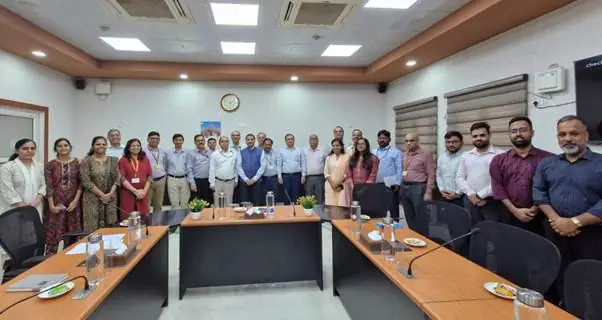
The Telecommunication Engineering Centre (TEC) observed World Standards Day 2026 in New Delhi with a clear message: standards are no longer a back-end technical function, but a front-line instrument of economic policy, digital sovereignty, and industrial competitiveness. The event highlighted India's increasingly visible role in global telecom standardisation, at a time when the country is seeking to move from being a large consumer of technology to a more influential contributor to the rules that govern it.
The gathering came against the backdrop of rapid change in communications technology, where the pace of innovation in 5G, emerging 6G research, network security, and digital infrastructure is forcing governments and regulators to engage more deeply with international standards bodies. For India, the stakes are high. Standards determine whether equipment from different vendors can work together, whether networks remain secure and scalable, and whether domestic industry can compete in global markets without being locked out by proprietary systems.
Standards as strategy
TEC's message in New Delhi reflected a broader policy shift: standardisation is increasingly being treated as a strategic domain rather than a narrow engineering exercise. In telecommunications, standards shape everything from spectrum efficiency and device compatibility to cybersecurity protocols and service quality. For a country with one of the world's largest telecom markets, the ability to influence those standards can translate into real economic and geopolitical leverage.
India's participation in global standard-setting forums has expanded in recent years as policymakers and technical institutions have pushed for greater alignment between domestic innovation and international norms. That effort is especially important as the country builds out digital public infrastructure, expands broadband access, and prepares for future network generations that will rely on more complex and interoperable systems. By stressing India's role at World Standards Day, TEC signaled that the country wants to be seen not merely as a rule-taker, but as a rule-shaper.
The event also served as a reminder that standards are essential to public policy outcomes that often go unnoticed by consumers. Reliable connectivity, secure communications, and smooth cross-border technology trade all depend on technical specifications agreed through long and often highly technical negotiations. In that sense, standardisation is one of the quiet foundations of modern governance.
Global telecom competition
India's push for a stronger voice in telecom standards comes at a moment of intense global competition. Major economies are racing to define the architecture of future networks, with implications for supply chains, intellectual property, cybersecurity, and industrial policy. Countries that help write the standards can shape the market conditions under which equipment is designed, certified, and deployed.
For India, this is particularly relevant because the country's telecom ecosystem is large, diverse, and increasingly innovation-driven. Domestic firms, research institutions, and public agencies have a growing interest in ensuring that global standards reflect the realities of large-scale deployment in emerging markets, including affordability, energy efficiency, and resilience. That perspective can be valuable in international forums where the needs of advanced economies do not always align with those of high-growth digital markets.
TEC's observance of World Standards Day also reinforced the importance of coordination between government, industry, academia, and standards organisations. Effective participation in global standardisation requires sustained technical expertise, long-term investment, and institutional continuity. It is not enough to attend meetings; countries must develop the capacity to contribute proposals, test interoperability, and build consensus around technical frameworks that can be adopted internationally.
Policy and industry impact
The policy implications extend beyond telecom alone. Standards influence procurement, manufacturing, certification, and export competitiveness across the broader digital economy. For India, stronger engagement in standardisation can support domestic production, reduce dependence on imported technical frameworks, and create a more favourable environment for innovation-led growth.
The New Delhi event therefore carried significance beyond ceremonial observance. It positioned standards as a policy tool that can support national priorities ranging from digital inclusion to industrial self-reliance. It also reflected a wider recognition within government that the next phase of telecom development will be shaped as much in standards committees as in laboratories or network rollouts.
As India looks ahead to the next generation of communications infrastructure, the ability to influence global standards may prove decisive. TEC's World Standards Day observance made that point plainly: in the digital era, the countries that help define the standard often help define the market. For India, the challenge now is to convert technical participation into lasting strategic influence.