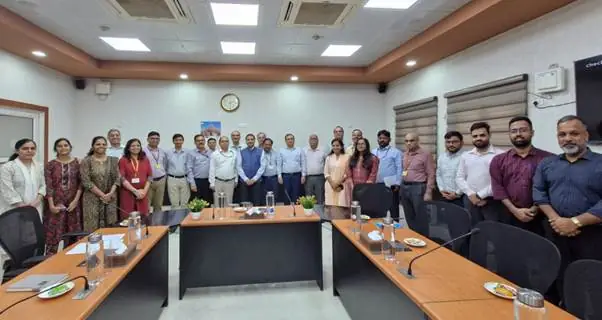
The Telecommunication Engineering Centre (TEC) observed World Standards Day 2026 in New Delhi with a clear policy message: India is no longer merely adopting global telecom standards, but increasingly helping shape them. The event placed standards at the centre of the country's digital infrastructure strategy, framing technical rule-making as a strategic lever for competitiveness, security, and international influence.
Standards as Strategy
World Standards Day is typically a technical observance, but TEC used the occasion to elevate the discussion into the realm of national policy. In a sector where devices, networks, and services must work seamlessly across borders, standards determine whether innovation scales or fragments. For India, that matters not only for consumer connectivity, but also for manufacturing, spectrum efficiency, network resilience, and the long-term credibility of its digital public infrastructure.
Officials and stakeholders at the event highlighted that telecom standardisation is no longer a back-end engineering issue. It is now a front-line policy domain that affects everything from 5G deployment and equipment certification to cybersecurity and the future transition toward 6G. By anchoring the discussion in World Standards Day, TEC signalled that India's telecom ambitions depend as much on participation in international standard-setting bodies as on domestic rollout targets.
The timing is significant. India is pursuing a larger role in global technology governance at a moment when telecom ecosystems are being reshaped by geopolitics, supply-chain realignment, and the race to define next-generation networks. Standards determine who sets technical benchmarks, whose equipment can interoperate, and which markets can scale efficiently. For a country with India's market size and manufacturing aspirations, that makes standards a matter of industrial policy as much as engineering discipline.
India's Global Push
TEC's message also reflected a broader shift in India's technology posture. Over the past several years, New Delhi has sought to move from being a large consumer market to a more assertive standard-shaping economy. That ambition is visible in telecom, where Indian institutions and experts are increasingly engaging with international forums that define technical specifications for network architecture, testing, certification, and interoperability.
This push has practical consequences. Stronger participation in standards bodies can help Indian priorities enter the global conversation earlier, reducing the risk that domestic networks and manufacturers are forced to adapt to rules written elsewhere. It can also support local industry by aligning research, testing, and certification ecosystems with international benchmarks, making Indian products more competitive abroad.
The event in New Delhi also served as a reminder that standards are inseparable from trust. In telecom, where networks carry financial transactions, public services, and critical communications, technical consistency is tied to reliability and security. A standards-led approach can reduce fragmentation across vendors and systems, improve compliance, and support more predictable deployment across public and private networks.
For India, this is especially important as the country expands digital services into deeper layers of the economy. The more the state and industry rely on connected systems, the more vital it becomes that those systems are built on interoperable and future-ready technical norms. TEC's observance of World Standards Day therefore carried a broader governance message: digital scale without standards is fragile, but digital scale with standards can become durable national capability.
Policy Stakes Ahead
The event comes at a time when telecom policy is increasingly intertwined with industrial strategy, research capacity, and international diplomacy. India's role in global standardisation will likely be judged not only by attendance in forums, but by the quality of its technical contributions, the depth of its expert ecosystem, and its ability to translate domestic innovation into globally accepted frameworks.
That will require sustained investment in laboratories, testing infrastructure, academic-industry collaboration, and expert participation in standards development organisations. It will also require coordination between regulators, public institutions, and private firms so that India speaks with greater coherence in international technical debates.
TEC's World Standards Day observance therefore was more than a ceremonial event. It was a policy signal that India views standards as a strategic asset in the telecom era. As the country positions itself for the next wave of connectivity, from advanced 5G applications to the early architecture of 6G, its influence will depend not only on how quickly it builds networks, but on how effectively it helps define the rules those networks follow.
In that sense, the New Delhi event captured a larger truth about India's digital future: the battle for leadership in telecom will be decided not just in towers and cables, but in standards rooms where the technical foundations of global connectivity are written.