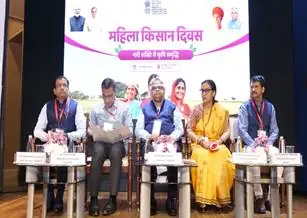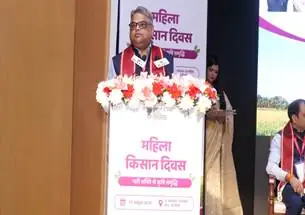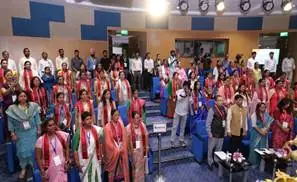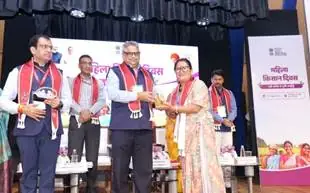
India's observance of Women Farmers Day 2026 has brought fresh scrutiny to a long-standing contradiction in the country's agricultural economy: women do a substantial share of farm labour, yet remain among the least visible beneficiaries of policy, ownership, and institutional support. The day, marked across government and civil society platforms, comes at a time when policymakers are under pressure to translate symbolic recognition into measurable gains in income, productivity, and legal rights for women in agriculture.
Policy Recognition Gap
Women are central to India's farm economy, from sowing and transplanting to harvesting, post-harvest handling, livestock care, and household food management. Yet their contribution is often recorded as unpaid family labour rather than as productive economic activity. That gap matters because it shapes how benefits are distributed, how farm households are counted, and how agricultural schemes are designed. In many states, women continue to work on land they do not own, limiting their access to formal credit, crop insurance, procurement systems, and compensation in the event of distress.
The policy challenge is not simply one of visibility. It is structural. Land titles remain overwhelmingly male-dominated, and without ownership documents, women farmers frequently struggle to access institutional finance or qualify independently for government support. Even where women are active cultivators, they are often treated administratively as dependents rather than decision-makers. This weakens the effectiveness of programmes that assume the household head is the primary farmer and leaves a large part of the rural workforce outside the core architecture of agricultural governance.
Credit And Land Access
The most pressing issue for women farmers remains access to land and credit. Experts have long argued that without secure tenure, women cannot fully participate in the formal agricultural economy. Land ownership is not only a question of inheritance or property rights; it is the gateway to loans, subsidies, insurance claims, and bargaining power in local markets. In many districts, women who cultivate land informally still depend on male relatives or intermediaries to interact with banks and state agencies.
Credit access is equally uneven. Although several schemes have sought to improve financial inclusion, women farmers often face documentation hurdles, lower collateral availability, and limited awareness of scheme eligibility. The result is a persistent gap between policy intent and on-ground delivery. Women's self-help groups and producer collectives have helped bridge some of these barriers, but their reach remains uneven across regions and crop systems. The broader question for the government is whether women's agricultural participation will be treated as a peripheral welfare issue or as a core productivity and governance priority.
Beyond Symbolic Observance
Women Farmers Day has increasingly become a platform to push for more than ceremonial recognition. Advocates argue that the day should be used to strengthen extension services tailored to women, expand training in climate-resilient farming, improve access to machinery suited to women's physical and economic realities, and ensure that women are represented in local water, seed, and market institutions. These measures are especially important as Indian agriculture faces rising climate volatility, labour shortages, and pressure to improve efficiency.
The significance of the day also lies in its policy timing. Rural distress, migration, and changing labour patterns have increased the burden on women in many farming households. In several regions, men have moved into non-farm work or migrated temporarily, leaving women to manage both cultivation and domestic responsibilities. That shift has made women de facto farm managers in many villages, even where official records continue to lag behind reality. Recognising that shift is essential if agricultural policy is to reflect how farming actually operates on the ground.
For the government, the challenge now is to convert observance into institutional reform. That means better data collection, stronger land rights enforcement, more inclusive credit systems, and targeted support that treats women not as supplementary labour but as primary agricultural stakeholders. Without that shift, Women Farmers Day risks becoming another annual reminder of a gap India already knows well: women sustain the farm economy, but the system still does not fully recognise them as farmers.