India's push to develop and scale a nutrient-rich purple potato marks more than a novelty in the country's agricultural landscape. It signals a policy direction that increasingly links crop innovation with nutrition security, farmer profitability, and resilience in a warming climate. As policymakers look for ways to diversify food systems beyond staple grains, the purple potato is emerging as a symbol of how agricultural science can be deployed to address both public health and rural economic goals.
Nutrition Meets Policy
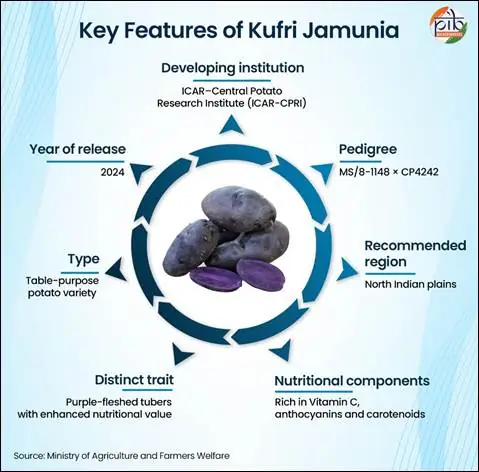
The purple potato stands out because of its naturally high levels of anthocyanins, the pigments that give it its distinctive colour and are widely associated with antioxidant properties. For a country where malnutrition remains a persistent challenge alongside rising diet-related health concerns, such crops are gaining attention as part of a broader strategy to improve the nutritional quality of everyday foods without requiring major changes in consumer behaviour.
This matters in India because policy debates around food security are shifting from calorie sufficiency to nutrient adequacy. For decades, the country's agricultural system has been shaped by the imperative to produce enough rice and wheat. That model delivered food stability, but it also narrowed crop diversity and left gaps in micronutrient intake. A crop like the purple potato fits into a newer framework that seeks to make agriculture more nutrition-sensitive while still remaining commercially viable for farmers.
The policy significance is also practical. Potatoes are already deeply embedded in Indian diets and supply chains, making them a familiar vehicle for nutritional innovation. Unlike entirely new crops that require consumer education from scratch, a coloured potato can enter markets through existing retail, processing, and household channels. That lowers adoption barriers and gives government and research institutions a more realistic path to scale.
Science In The Field
The development of the purple potato also reflects the growing role of agricultural research in shaping national policy outcomes. Crop breeding, seed development, and varietal improvement are no longer viewed only as technical exercises; they are increasingly tied to public objectives such as nutrition, climate adaptation, and import reduction. In that sense, the purple potato is part of a larger effort to make Indian agriculture more knowledge-intensive.
The crop's appeal extends beyond its nutritional profile. If successfully adapted to Indian growing conditions, it could offer farmers a differentiated product with potential premium pricing in urban markets, food processing, and health-conscious consumer segments. That would be especially important in a farm economy where margins are often thin and price volatility can erode earnings. A higher-value potato variety could help diversify income streams without forcing farmers to abandon familiar cultivation patterns.
There is also a climate dimension. As weather variability intensifies, policymakers are under pressure to promote crops and varieties that can perform reliably under changing conditions. While the purple potato is not a climate solution by itself, its development fits into a broader portfolio approach that emphasizes crop diversification and genetic improvement as tools for agricultural resilience.
Market And Farm Impact
The real test, however, will be whether the purple potato can move from research interest to mainstream cultivation. That will depend on seed availability, agronomic performance, consumer acceptance, and the ability of supply chains to preserve quality from farm to market. Without those elements, even a scientifically promising crop can remain a niche product.
For the government, the opportunity lies in aligning research institutions, extension systems, and market incentives. If the crop is positioned only as a laboratory success, its policy value will be limited. But if it is integrated into nutrition programmes, horticulture promotion, and farmer outreach, it could become a model for how India commercialises science-backed crops.
The broader significance is clear: India is increasingly trying to move from food security defined by volume to food security defined by quality. The purple potato is a small but telling example of that transition. It suggests that the next phase of agricultural policy may be less about producing more of the same and more about producing better food, with stronger links between the field, the market, and the public health system.