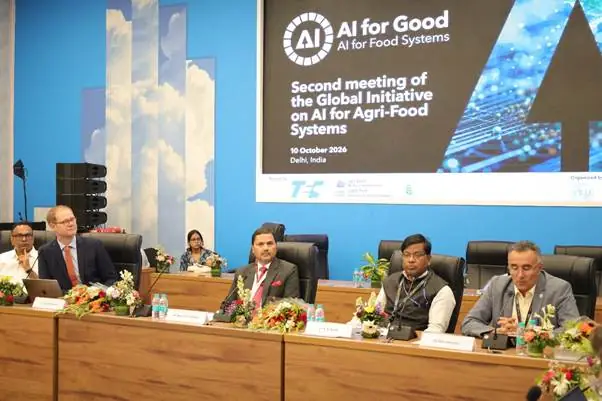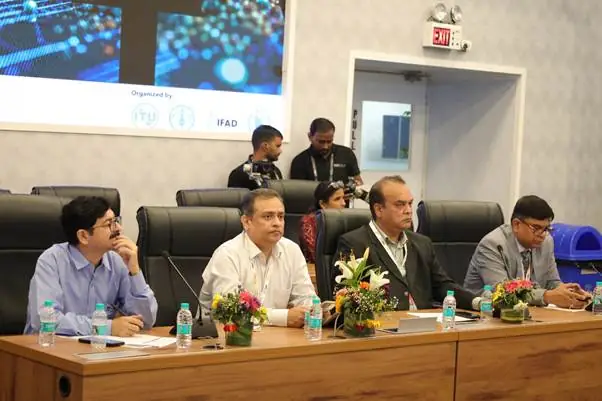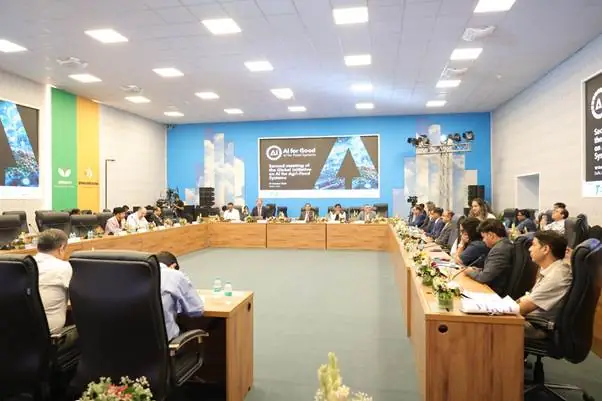
The second meeting of the Global Initiative on AI for Food Systems, or GI-AI4FS, was held in New Delhi as part of IMC 2026, placing agricultural technology and governance squarely on the policy agenda at a time when governments are searching for scalable tools to strengthen food security. The meeting reflected a broader international shift: artificial intelligence is no longer being discussed only as a frontier technology for industry and services, but as a practical instrument for agriculture, supply chains, climate adaptation, and rural livelihoods.
The New Delhi session came against the backdrop of rising pressure on food systems from erratic weather, input cost volatility, labour shortages, and the need to raise farm productivity without deepening inequality. In that context, GI-AI4FS is emerging as a platform to coordinate how AI can be applied to agriculture and allied sectors in ways that are both effective and accountable. The choice of India as host is significant. The country has been positioning itself as a leader in digital public infrastructure, and the food and agriculture sector is increasingly seen as the next major test case for translating digital capacity into measurable public value.
Policy Meets Technology
The meeting highlighted a central policy question: how can governments use AI to support farmers and food systems without creating new forms of exclusion? That issue is especially relevant in countries with large smallholder populations, where uneven access to data, connectivity, devices, and advisory services can limit the benefits of advanced tools. AI models can help forecast weather impacts, detect crop stress, optimize irrigation, improve pest management, and strengthen logistics, but their usefulness depends on the quality of local data and the ability of institutions to deliver recommendations at scale.
For India, the discussion also fits into a wider governance framework that has increasingly linked technology with public service delivery. The agricultural sector has long faced fragmentation across land records, extension services, market intelligence, and procurement systems. AI offers the prospect of integrating these layers more intelligently, but only if policy design keeps pace with the technology. That means standards for data use, safeguards for privacy, transparency in algorithmic decision-making, and mechanisms to ensure that public systems do not become dependent on opaque private platforms.
Food Systems Under Pressure
The timing of the meeting is notable because food systems globally are under sustained strain. Climate shocks are disrupting planting cycles and harvests, supply chains remain vulnerable to geopolitical and logistical disruptions, and governments are under pressure to maintain affordability for consumers while protecting farm incomes. In this environment, AI is being framed not as a speculative innovation, but as a resilience tool.
Yet the promise of AI in agriculture is often overstated when detached from implementation realities. Predictive tools require reliable ground data, local calibration, and trusted delivery channels. A model that works in one agro-climatic zone may fail in another. That is why multilateral and cross-border initiatives such as GI-AI4FS matter: they can help establish shared principles, technical cooperation, and common benchmarks for responsible use. The New Delhi meeting therefore carried importance beyond symbolism. It signaled an effort to move from broad enthusiasm about AI toward practical governance architecture for food systems.
The initiative also reflects a growing recognition that digital agriculture cannot be treated as a purely technical project. It is a policy domain that intersects with rural development, market regulation, climate adaptation, and public procurement. If AI is to improve food systems, it must be embedded in institutions that can interpret data, act on recommendations, and protect vulnerable users from misuse or overreach.
India's Strategic Signal
Hosting the second GI-AI4FS meeting at IMC 2026 allowed India to project itself as a convening power in the global debate on AI governance. The country has repeatedly argued that technology policy should be inclusive, development-oriented, and grounded in public interest. Agriculture is one of the clearest arenas where that philosophy can be tested.
The broader strategic signal is that India wants to shape not only domestic adoption of AI, but also the international norms that will govern its use in essential sectors. Food systems are politically sensitive, economically vital, and socially consequential. Any AI framework in this space must balance innovation with safeguards, efficiency with equity, and scale with accountability. The New Delhi meeting suggests that this balance is now becoming a serious policy conversation rather than a distant aspiration.
As governments and institutions look for ways to modernize agriculture, the GI-AI4FS platform may become an important venue for aligning technology with public goals. The New Delhi meeting at IMC 2026 did not just showcase AI as a tool for farming; it framed AI as a governance challenge, a development opportunity, and a test of whether digital systems can truly serve the people who produce and consume the world's food.