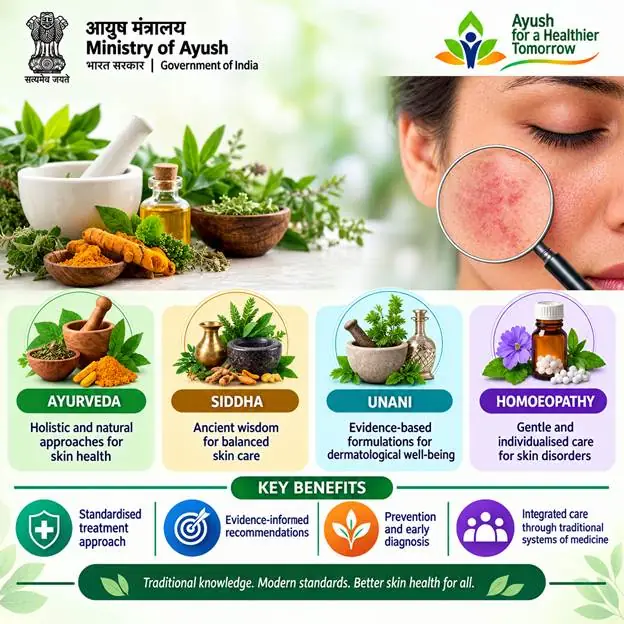
The Ministry of Ayush has issued fresh guidelines for the treatment of skin-related disorders across four traditional medical systems, a policy move that underscores New Delhi's effort to bring greater clinical discipline and standardisation to India's traditional healthcare sector. The guidance is intended to provide practitioners with a more structured framework for diagnosis, treatment selection, and patient management, while also signalling the government's continuing push to align traditional medicine with modern expectations of safety, accountability, and evidence-informed care.
The announcement comes at a time when traditional medicine is receiving renewed policy attention in India, both as a domestic healthcare resource and as a sector with growing global visibility. Skin disorders are among the most common reasons patients seek medical attention, and they often require long-term management, careful monitoring, and clear treatment protocols. By focusing on this category, the ministry is addressing a field where patients frequently move between conventional and traditional systems, sometimes without coordinated oversight. The new guidelines are therefore likely to be read as an attempt to reduce inconsistency in clinical practice and improve confidence in treatment outcomes.
Clinical Standardisation Push
The central significance of the guidelines lies in their emphasis on standardisation. Traditional medicine in India has long been characterised by diversity of practice, regional variation, and practitioner-specific interpretation. While that diversity is often presented as a strength, it can also create unevenness in care delivery, especially in conditions that require sustained follow-up. Skin disorders, which may range from chronic inflammatory conditions to recurrent infections and pigment-related complaints, are particularly vulnerable to such variation. A more uniform framework can help practitioners make decisions with greater clarity and may also make it easier for patients to understand what to expect from treatment.
The ministry's move also reflects a broader regulatory trend within the Ayush ecosystem: the effort to move from broad promotion of traditional systems toward more defined clinical governance. That shift matters because the sector has expanded significantly in public visibility, institutional support, and market size. As the government seeks to position traditional medicine as a credible component of India's health architecture, the pressure to demonstrate consistency, safety, and measurable benefit has intensified. Guidelines for specific disease categories are one way to meet that demand.
Policy And Public Health
From a public health perspective, skin disorders are not a niche concern. They affect quality of life, productivity, mental well-being, and in some cases signal deeper systemic illness. In India, where access to dermatology services can be uneven across regions, traditional medicine systems often serve as an accessible first point of care. That reality gives the ministry's guidance practical significance beyond the policy domain. If implemented effectively, the guidelines could help practitioners identify cases that are suitable for traditional treatment and those that require referral to specialist or emergency care.
The policy also carries implications for patient safety. One of the recurring criticisms of loosely regulated traditional care is the risk of delayed diagnosis or inappropriate treatment in conditions that need closer medical supervision. Clearer guidance can help reduce that risk by encouraging more disciplined clinical judgment. It may also support better documentation and follow-up, both of which are increasingly important as health systems move toward integrated and accountable care models.
At the same time, the release of guidelines does not by itself resolve the larger challenge of implementation. The effectiveness of such measures depends on how widely they are disseminated, whether practitioners are trained to use them, and whether institutions are able to monitor compliance. Without that operational layer, even well-crafted guidance can remain largely symbolic. The ministry will likely need to pair the document with training, professional engagement, and periodic review if it wants the policy to shape actual practice.
Broader Sector Signal
The timing of the announcement is also notable because it reinforces the government's broader narrative around traditional medicine as a modern policy domain rather than merely a heritage sector. By issuing disease-specific guidance, the ministry is effectively asserting that traditional systems must be evaluated and managed through the same lens of clinical responsibility that governs other parts of the health sector. That approach may appeal to policymakers seeking to expand access while preserving standards.
For the Ayush sector, the guidelines could also have downstream effects on education, research, and institutional practice. Medical colleges, hospitals, and practitioners may increasingly be expected to align with official protocols, especially in areas where treatment claims intersect with public trust. Over time, such guidance can shape not only how care is delivered but also how traditional medicine is studied, regulated, and communicated to the public.
The ministry's decision therefore represents more than a technical update. It is part of a larger state-led effort to define the boundaries of traditional medicine in a way that is clinically coherent and administratively manageable. In a healthcare environment where patients are demanding both accessibility and accountability, the new skin-disorder guidelines may prove to be an important marker of how India intends to govern its traditional medical systems in the years ahead.