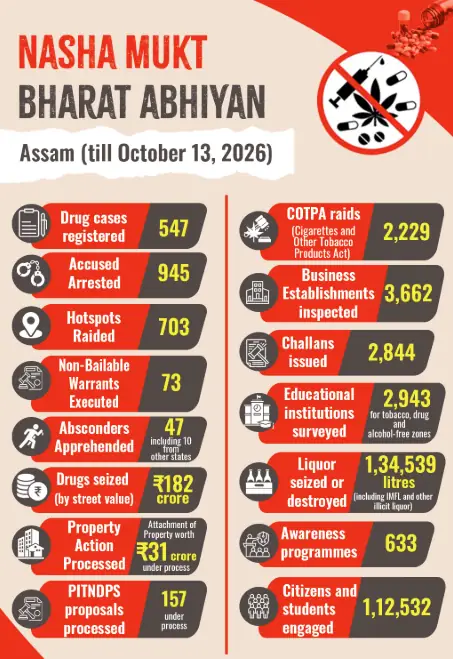
Union Home and Cooperation Minister Amit Shah has publicly commended the Assam Chief Minister and the Assam Police for their continued campaign against narcotics, describing the state's action as a decisive strike against drug networks. The praise, delivered in the context of an ongoing national push against illicit drugs, reflects the central government's effort to project a tougher, more coordinated enforcement posture across vulnerable transit corridors.
Strong Federal Signal
Shah's remarks are significant not merely as a routine political endorsement, but as a reaffirmation of the Centre's backing for state-led enforcement in one of India's most strategically sensitive regions. Assam sits at the intersection of multiple trafficking routes, with its geography making it both a transit point and a target for narcotics syndicates operating across borders and through internal distribution chains. In that context, the Home Minister's praise serves as both recognition and reinforcement: recognition of the state's operational gains, and reinforcement of the message that anti-drug enforcement remains a national priority.
The statement also highlights the broader governance model that the Union government has increasingly promoted in recent years — one in which state police forces, central agencies, and political leadership are expected to act in concert against organized crime. By commending the Assam Police, Shah effectively underscored the importance of sustained field-level policing, intelligence-led operations, and inter-agency coordination in dismantling drug networks rather than merely intercepting individual consignments.
Northeast Under Pressure
The Northeast has long been a focal point in India's anti-narcotics strategy because of its proximity to international trafficking routes and the ease with which illicit substances can move through porous terrain and fragmented enforcement zones. Assam, in particular, has emerged as a key battleground in this effort. Repeated seizures, arrests, and network disruptions in the state have made narcotics control a central law-and-order and public health issue, not just a policing matter.
Shah's praise comes at a time when the political and administrative stakes of anti-drug enforcement remain high. Drug trafficking is increasingly understood as a multi-layered threat: it fuels addiction, finances criminal networks, corrodes local institutions, and places pressure on border security. For state governments, visible action against narcotics can also serve as a measure of administrative effectiveness, especially when linked to broader campaigns around youth protection, public safety, and social stability.
Assam's anti-drug operations have therefore acquired symbolic weight beyond the immediate seizures or arrests involved. They are being framed as part of a larger effort to deny criminal networks the space to operate and to demonstrate that sustained policing can alter the economics of trafficking. Shah's public commendation strengthens that framing and may also encourage other states to intensify similar drives.
Enforcement And Politics
The Home Minister's statement also carries a political dimension. Public praise from the Centre can help validate a state government's law-and-order agenda while aligning it with the Union government's national narrative on security and governance. In a federal system, such endorsements matter because they signal policy continuity, administrative confidence, and political alignment on a sensitive issue that cuts across party lines.
At the same time, the anti-drug campaign is not simply about enforcement optics. The challenge lies in sustaining pressure on supply chains, identifying financiers and handlers, and ensuring that arrests translate into durable disruption of trafficking ecosystems. That requires investigative depth, judicial follow-through, and coordination between police, customs, border forces, and narcotics control mechanisms. Without that broader architecture, crackdowns risk becoming episodic rather than transformative.
Shah's remarks suggest that the Centre views Assam as a key partner in this longer campaign. The emphasis on "continuous action" and "decisive blows" indicates a preference for persistent disruption over one-off operations. It also reflects the government's recognition that narcotics trafficking is adaptive: when one route is blocked, networks often shift geography, logistics, or product mix.
For now, the message from New Delhi is clear. Assam's anti-drug drive has earned top-level approval, and the Centre appears intent on keeping the pressure on trafficking networks through sustained cooperation with state authorities. In the broader national policy context, the statement reinforces an increasingly hard-edged approach to narcotics enforcement, one that treats drug control as a core governance and security imperative rather than a narrow criminal justice issue.