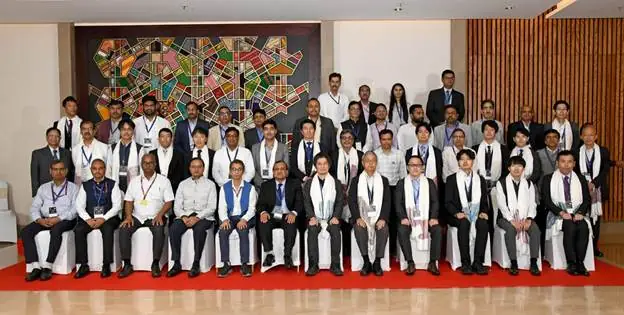
India and Japan have held the 12th session of their Joint Working Group on roads and road transport, a technical but strategically important forum that has become a steady channel for cooperation on one of India's most consequential governance priorities: building faster, safer and more resilient transport infrastructure.
The meeting comes at a time when India is pushing an ambitious road-building and logistics modernization agenda, while also trying to improve road safety, reduce travel times, and strengthen the efficiency of freight movement across states. For Japan, the engagement reflects a broader development partnership with India that has long extended beyond financing into standards, engineering practices, project management and institutional capacity-building.
Strategic Infrastructure Ties
The Joint Working Group mechanism is designed to keep the two governments aligned on policy and implementation issues in the road and transport sector. While such sessions are often low-profile, they are significant because they allow both sides to review ongoing cooperation, identify bottlenecks, and explore new areas of collaboration in a sector that directly affects economic growth, industrial competitiveness and public safety.
India's road network is central to its national development strategy. Highways carry the bulk of domestic freight and connect production centers to ports, markets and logistics hubs. Any improvement in road quality, traffic management or corridor planning can have a multiplier effect on trade, mobility and investment. Japan's role in this ecosystem has historically been associated with high-quality infrastructure support and a preference for long-term, technically rigorous engagement.
The 12th session also signals continuity in bilateral administrative cooperation. In governance terms, repeated working group meetings matter because they create institutional memory and help translate broad diplomatic goodwill into practical outcomes. That is especially relevant in infrastructure, where delays, land issues, financing structures and maintenance standards can determine whether projects deliver durable value or merely add capacity on paper.
Policy Meets Delivery
The road and transport sector in India is no longer just about construction. It now encompasses safety engineering, digital monitoring, tolling systems, corridor integration, environmental compliance and freight efficiency. That broader policy frame makes international technical cooperation more valuable, particularly when a partner brings experience in precision planning and lifecycle management.
Japan's infrastructure cooperation with India has often been viewed as complementary to India's domestic policy priorities rather than substitutive. In practical terms, that means the emphasis is likely to remain on knowledge exchange, project support and institutional strengthening rather than headline-grabbing announcements. Such cooperation can influence how projects are designed, how contractors are supervised, and how standards are enforced after completion.
For India, the challenge is not only to build more roads but to ensure that the network is safer and more productive. Road accidents remain a major public policy concern, and transport inefficiencies continue to raise costs for businesses and consumers. Any cooperation that improves design quality, traffic flow, maintenance planning or safety enforcement can therefore have direct economic and social benefits.
The session also fits into a wider pattern of India-Japan engagement in strategic infrastructure. Over the years, the relationship has expanded across transport, urban development, industrial corridors and connectivity projects. Roads and road transport are a natural part of that portfolio because they sit at the intersection of economic policy, regional development and state capacity.
What To Watch Next
The immediate significance of the 12th session lies less in a single announcement and more in what it may unlock over the coming months. Observers will be watching for indications of new technical initiatives, follow-up meetings, or project-level cooperation that could emerge from the dialogue. Any progress on standards, training, safety systems or corridor planning would reinforce the practical value of the forum.
The session also arrives as India continues to emphasize infrastructure as a core pillar of growth. In that context, partnerships with countries such as Japan are important not only for capital and expertise, but also for discipline in execution. For New Delhi, the test is whether such engagements can help convert policy ambition into measurable improvements on the ground.
At a broader level, the 12th Joint Working Group session reflects a mature bilateral relationship in which infrastructure cooperation has become a stable and recurring feature. In a sector where timelines are long and outcomes are cumulative, that kind of continuity may be as important as any single project announcement.